Fullbay
marketplace
Redesign
Web App
Transforming a hidden tool to a revenue powerhouse.
As Senior Product Designer, I led the end-to-end redesign of the Fullbay Marketplace with the goal of: increasing visibility, improving usability, and unlocking new revenue streams through vendor partnerships., which resulted in 30% company-wide revenue growth within the first 12-months, and 70% customer satisfaction rating (up from 9%).
year
2023
Company
Fullbay
Role
Senior Product Designer
Project Duration
6 Sprints
After
Before
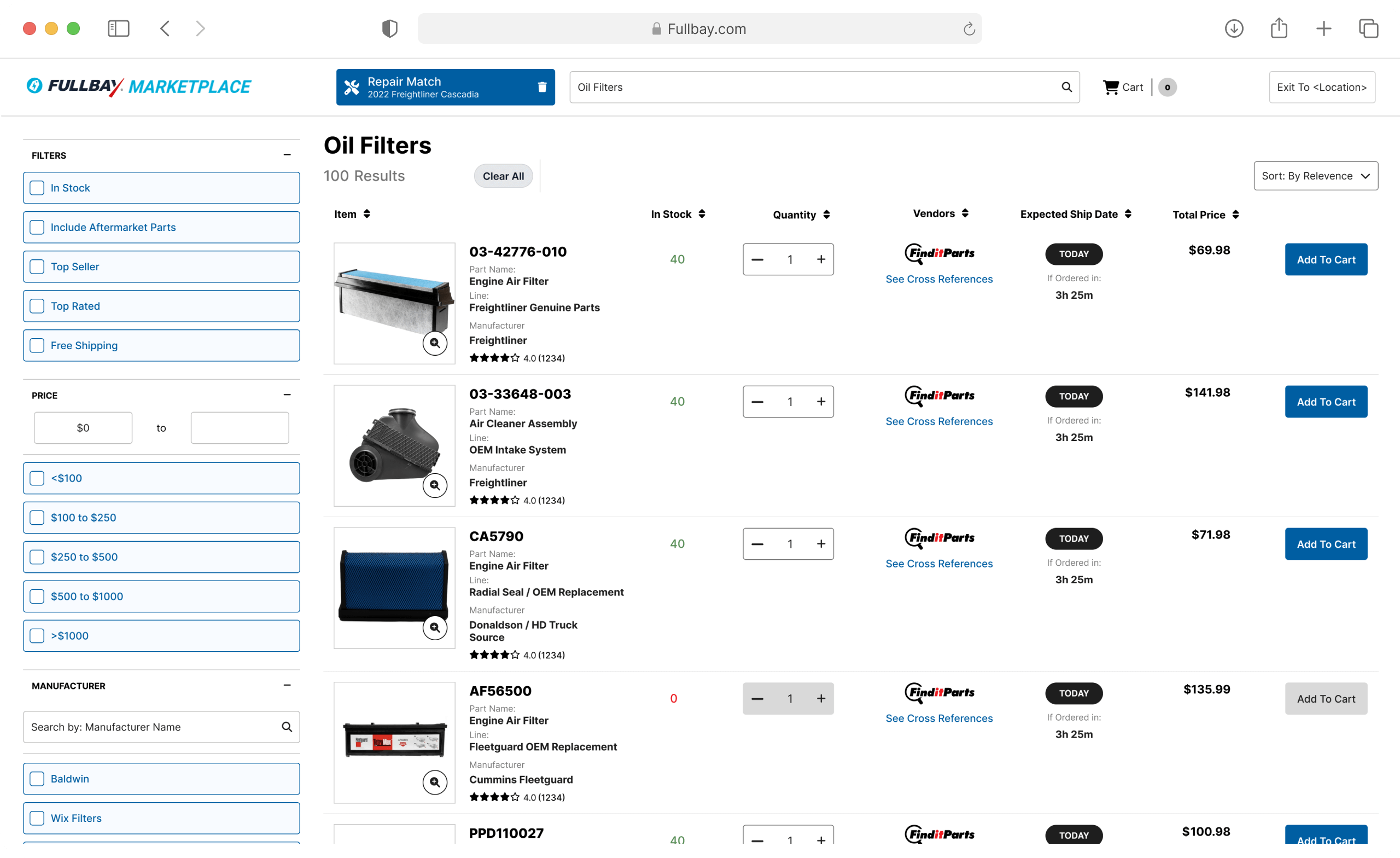
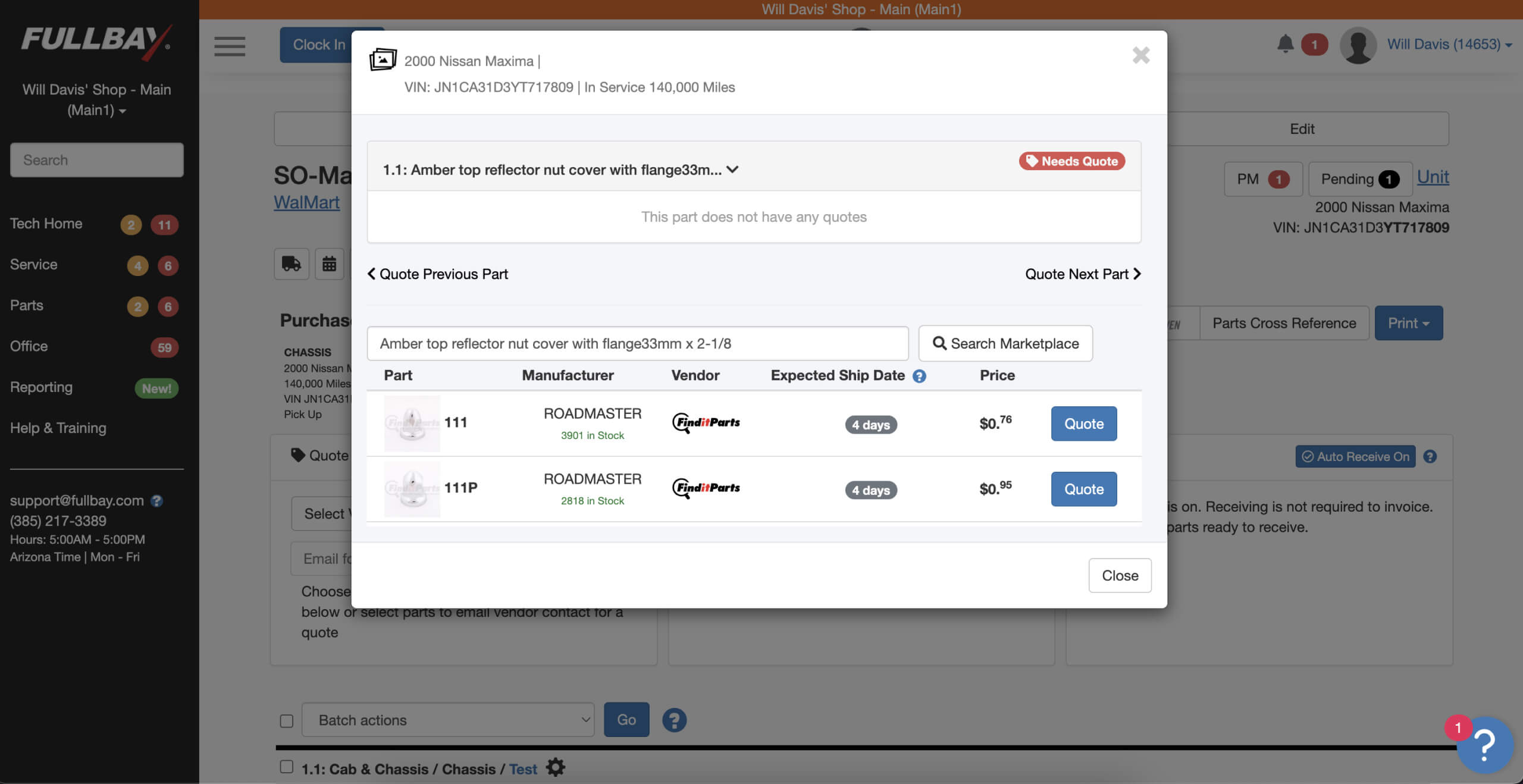
A before and after view comparison of the marketplace feature from its original state to the redesign
PRIMARY OBJECTIVES
What Did We Set Out to Achieve?
The feature was developed to serves as a business development lever, allowing distributors to sell products within the platform in exchange for a share of revenue from completed quotes. However, since its introduction, Fullbay had secured one distributor partnership. We saw this as an opportunity to explore its full potential as a consistet revenue driver in both the short and long term.
business related
What was the primary business opportunity for this project?
Increase Marketplace sales by 2X within two months of implementation by improving user engagement and simplifying the purchasing process.
The Marketplace feature contributed $15k in sales in 2021, accounting for 0.5% of overall revenue.
User related
In what way did we want to improve the overall user experience
Integrate the feature into the workflow to be an asset rather than a hinderance to an already complicated experience.
85% of users were unaware of the feature and uncertain about its benefits to their daily operations.
PRIMARY CONSTRAINTS
Addressing the historical context as to why this feature has been underutilized
While this feature was intended for revenue generation, we needed to take into account that there needed to be a foundation built around it to garner success.
The feature was created and maintained without design input
Following Fullbay’s founding, the Marketplace received minimal technical support compared to other areas of the product. Design and engineering resources were concentrated on foundational improvements aligned to business objectives and customer feedback, with no structured evaluation of the Marketplace’s health or performance during that time. This left the feature in a perpetual MVP state.
Unaddressed Technical and Design Debt
Due to limited ongoing investment, technical and design debt accumulated to a point where it needed to be addressed before any forward progress was possible. As a result, the feature was deprioritized on product roadmaps for approximately five to six years.
The Feature was visually buried and cumbersome to use
The application suffered from overly complex usability, with limited application of established design and technical best practices. This resulted in onboarding flows that often took multiple days to complete for both customers and internal teams. When users did reach the marketplace, data showed an abandonment rate approaching 94%, driven primarily by instability and friction within the experience.
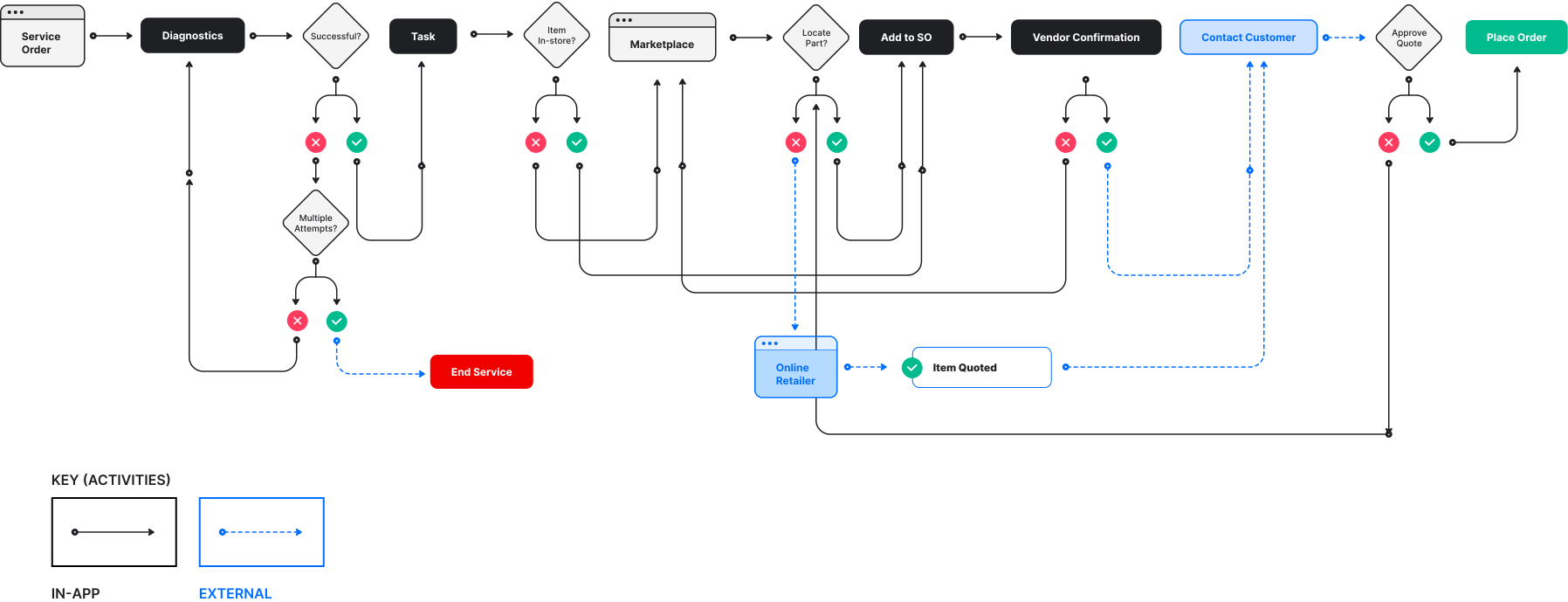
A visual representation of the original user flow (from feature entry to quote completion.
Overall Business Sentiments about the marketplace
By shadowing onboarding customer meetings, sales calls, and roadmap meetings where this effort was discussed, design was able to get a full cope of not only expectations but general sentiments about the markplace feature as well as design itself, we were then able to narrow this information to following as key points of focus and indicators of what success would look like from their perspective:
1
lack of trust in design
Historically, design efforts were considered a hinderence to the overall progress of the app.
2
Resource allocation
Lack of dev resources and time (originally quoted at only taking 1 sprint to complete)
3
uninformed users
Lacking proper user/customer education for the feature
4
Lack of user interest
Pure usage stats of the apps indicated a lack of interest from a client perspective.
STRATEGY
Rebuilding Marketplace from the ground up
To begin reimagining the Marketplace, I led a user-centered, systems-level strategy that combined user research and business alignment to establish the projects focus.
What started as a minor task triggered the features re-design
The initial request focused on a quick modification to indicate part fitment during the quoting process within the marketplace in the form of a badge. Through collaboration across design, development, and product management, the team identified this work as an opportunity to introduce long-needed process alignment and create a more seamless cross-functional workflow. -- From a design perspective, I wanted to first respect the given timeline and present a solution to collaborators and stakeholders that was true to the existing workflow but address the issues of visual hierarchy and overall flow before embarking on this new venture to gauge their sentiments of added value.
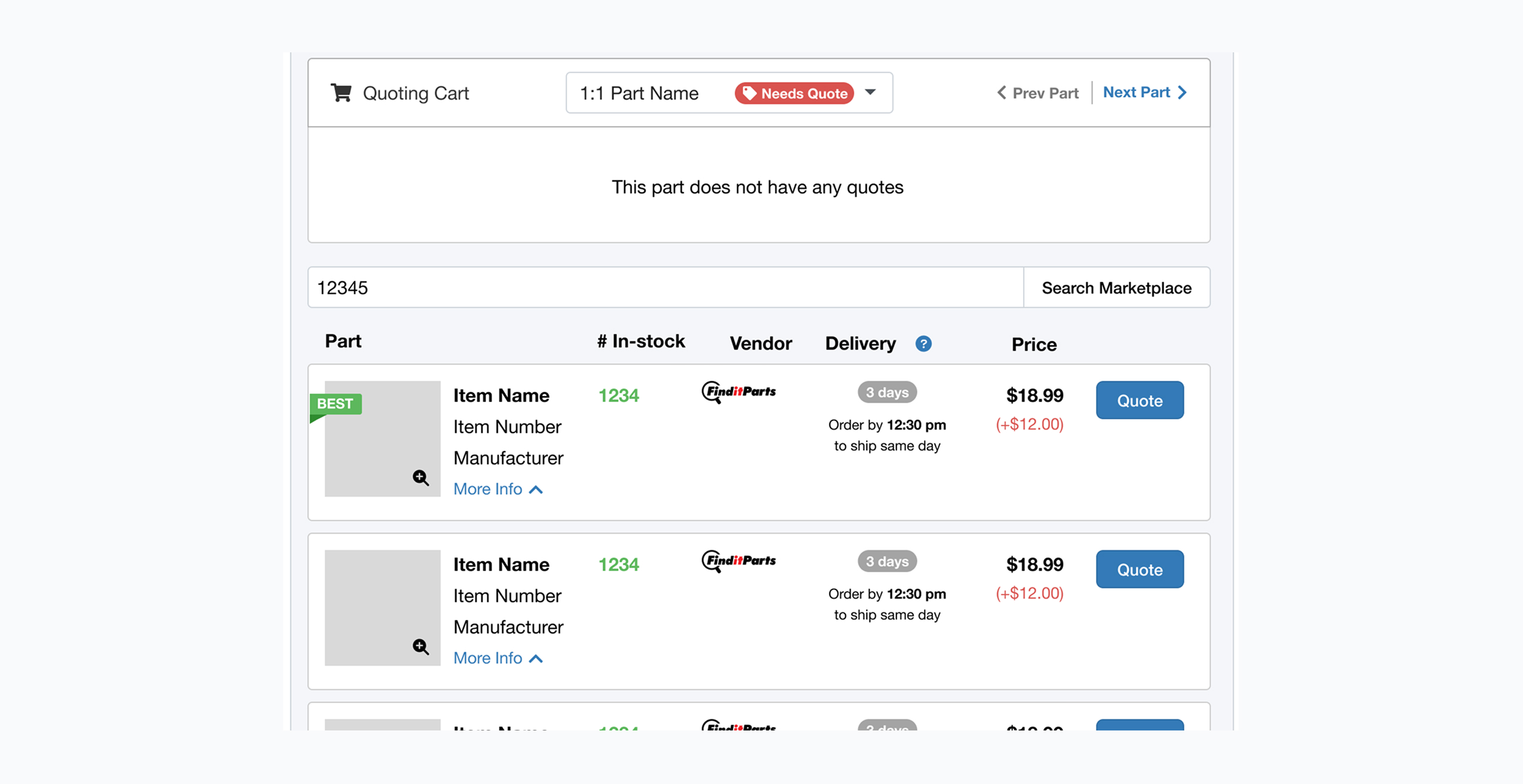
After
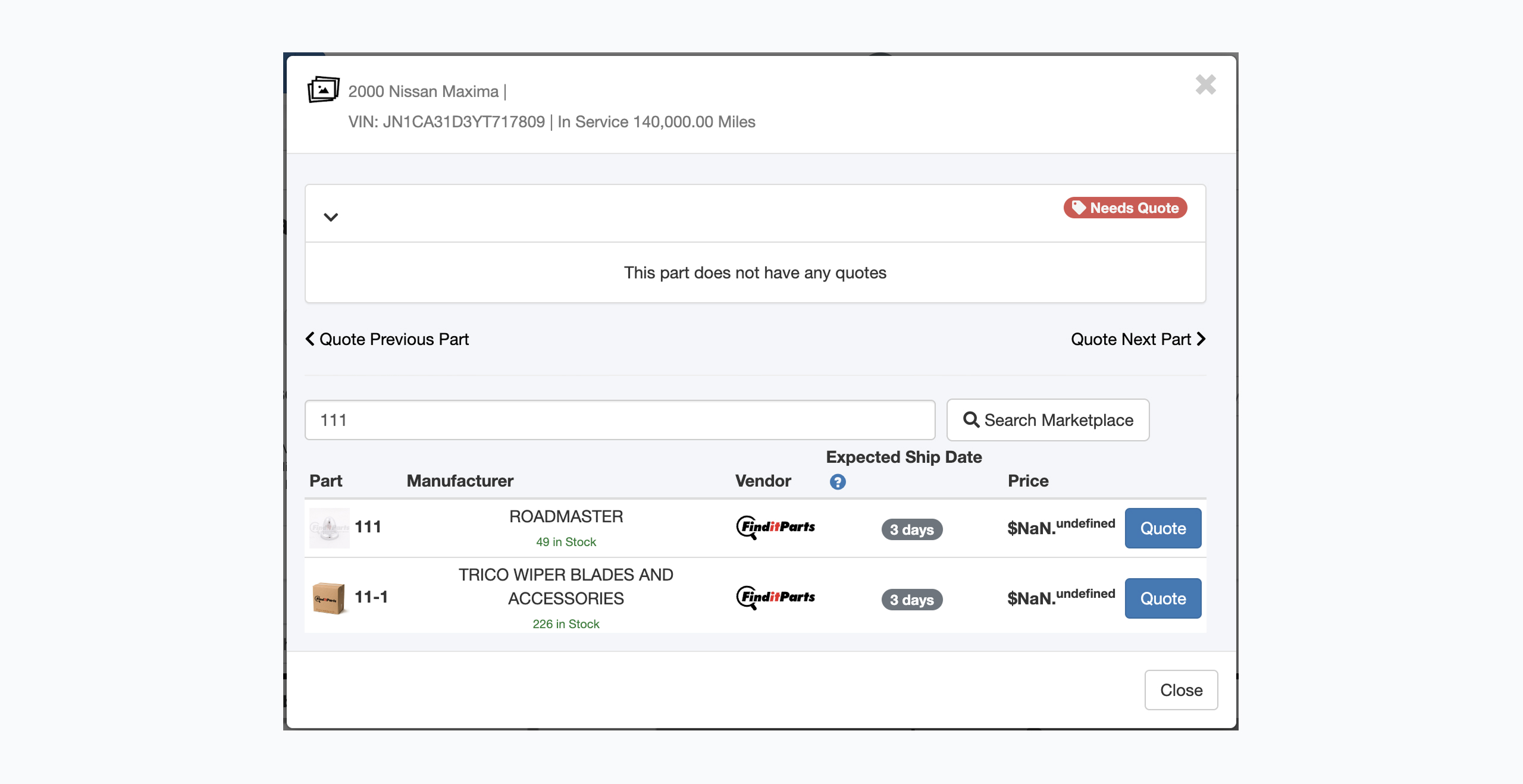
Before
The modified marketplace had distinctions of: navigating between established parts requiring a quote, an area where the selected items would be visible before submitting the quote, and more scannable information for results that would allow technicians to make comparisons between parts within the area window.
prEliminary research
To mitigate any biases and to solidify the actual need for this effort, I then utilized Pendo to create funnels and user flows to better understand the relationship between the marketplace and Fullbay users. Here are some notable outcomes I discovered:
Task Completion
Sample Size: 25,000 sessions
96%
of users encountered issues when searching and selecting items to quote.
94%
Cart abandonment rate when the user selects a part to quote
$15K
revenue generation over a 12-month period.
Heat Mapping
Sample Size: 320,000 sessions
6%
of all fullbay users engaged with the marketplace.
3%
of users who engaged with the marketplace used it again.
USer SAtisfaction
Sample Size: 240,000 sessions
9%
*Results were calculated from a self-selected in-app survey.
By synthesizing user data even further, we identified three key trends that shaped technicians’ decision-making when sourcing parts to either restock shop inventory or while addressing a service order. These trends became a primary focus in guiding the redesign.
Data Insights
Top 3 Quoting Attributes
45%
Availability / Delivery Time
Shops prioritize parts that are in stock and can be delivered quickly. Fast delivery keeps bays moving and minimizes vehicle downtime.
30%
Price / Cost
Competitive pricing matters, especially for high-volume or expensive parts. Shops often compare vendors to find the best deal without sacrificing too much on quality.
25%
Quality / Brand / Warranty
Technicians rely on trusted brands and OE-quality parts to reduce comebacks and ensure customer satisfaction. A strong warranty or low return rate can heavily influence their choice.
established project focus
By gathering these insights, design and collaborators were able to establish a focus for this effort for both strong and long-term investment. The following workflow was established as a result:
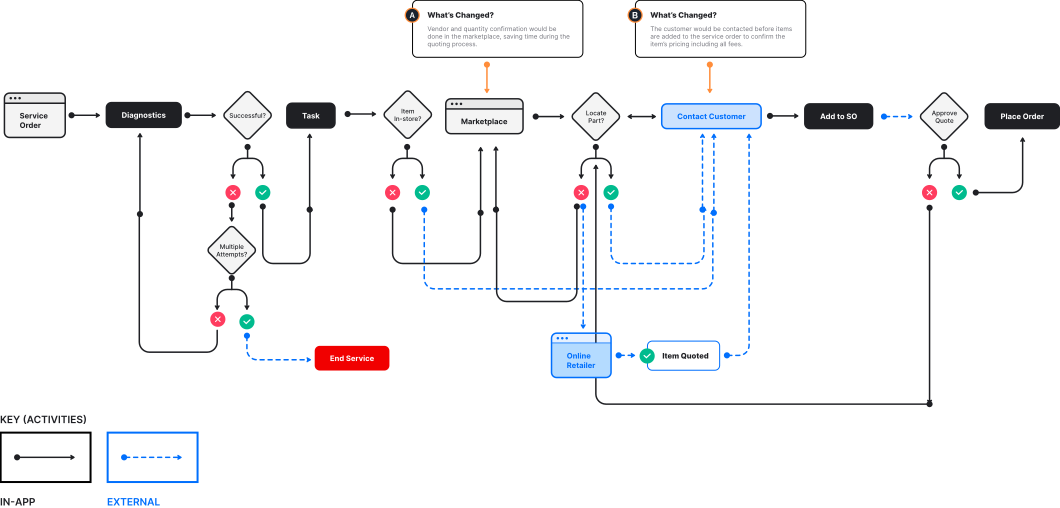
A
What's changed?
Vendor and quantity confirmation would be done in the marketplace through API calls, saving time during the quoting process.
B
what's changed?
The customer would be contacted before items are added to the service order to confirm the item’s pricing including all fees.
Initial revenue goal
I was then able to identity a primary user flow with the research and information we've gathered to begin designing out a final solution to test and build.
Initial Revenue Goal
How did the business come up with this figure?
+.05%
$30K Revenue
By Analyzing the average cost of items successfully quoted within SOs from external vendors (including fees associated with taxes and disposal/recycling), then adjusting this cost to the same items found within Fullbay’s primary internal vendor.
EXECUTION
The New Marketplace
By looking beyond the marketplace in isolation and addressing the systems and touchpoints it influenced, I was able to design solutions that more appropriately supported its use and long-term viability.
Service order > Marketplace Entry
How the user access the marketplace from a service order.
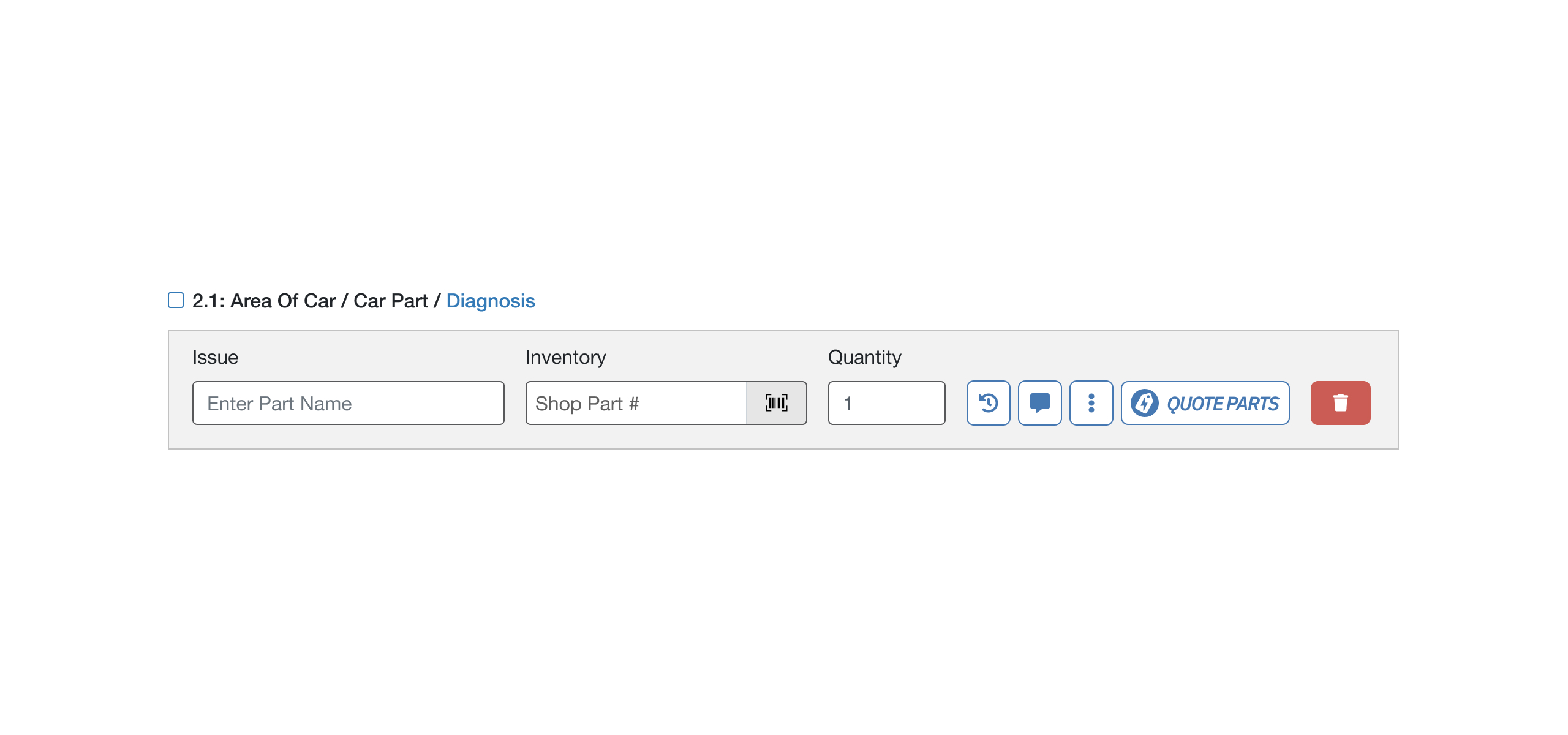
After
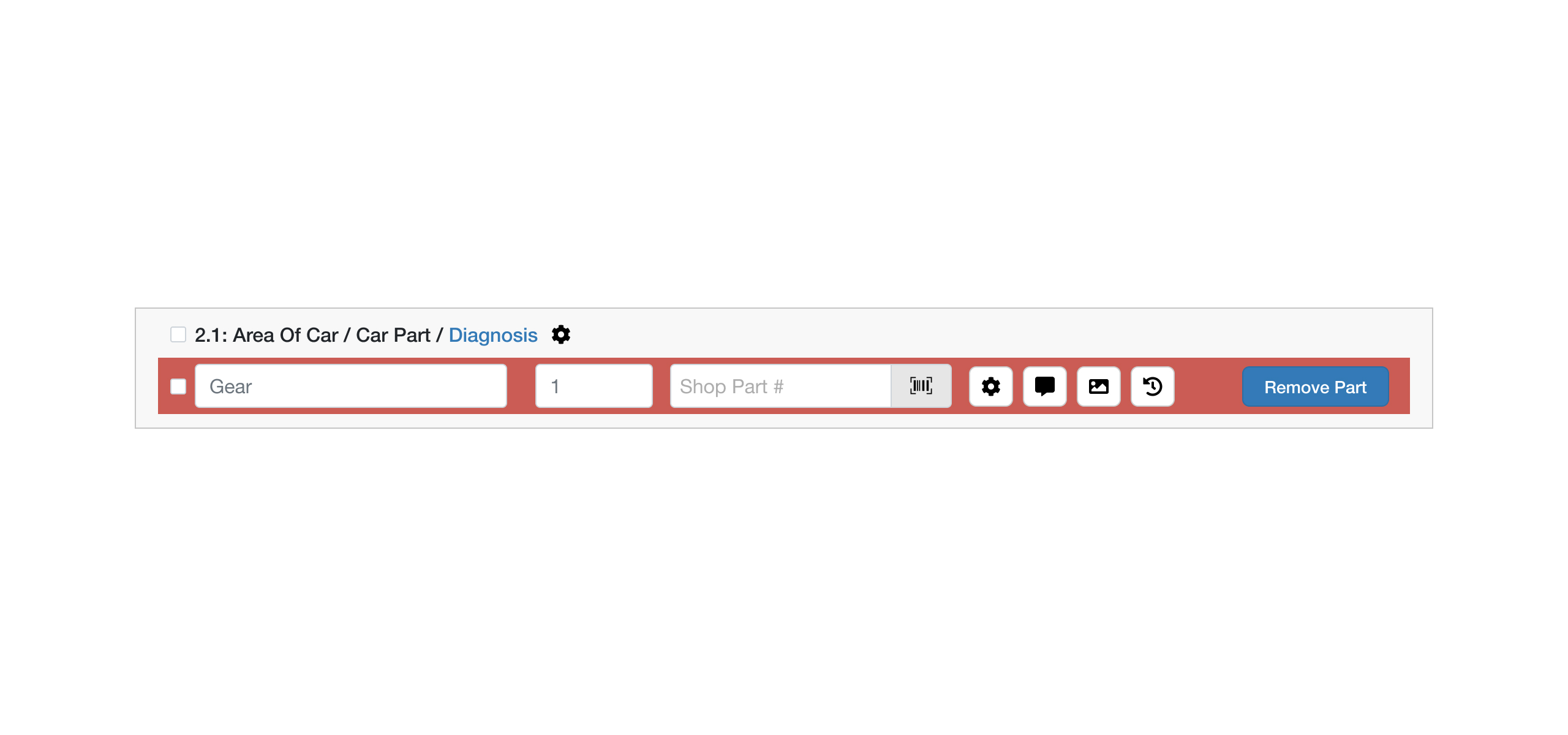
Before
By analyzing the typical usage of SO’s, we identified a discrepancy with the options included on each line. Previous efforts supporting the service order experience resulted in placing additional visual artifacts on screen without further analysis.
Service order > Inventory Entry
How the user access the marketplace from the inventory section of the app/
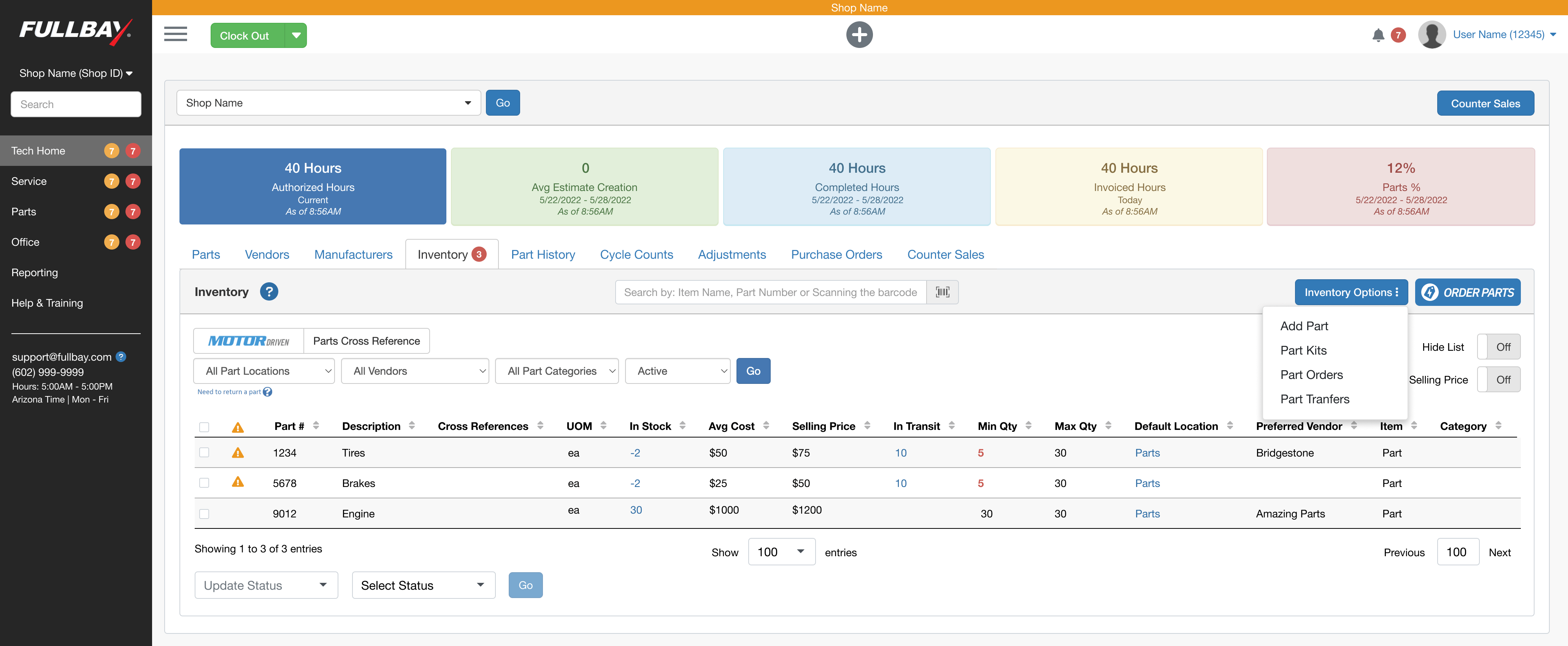
After
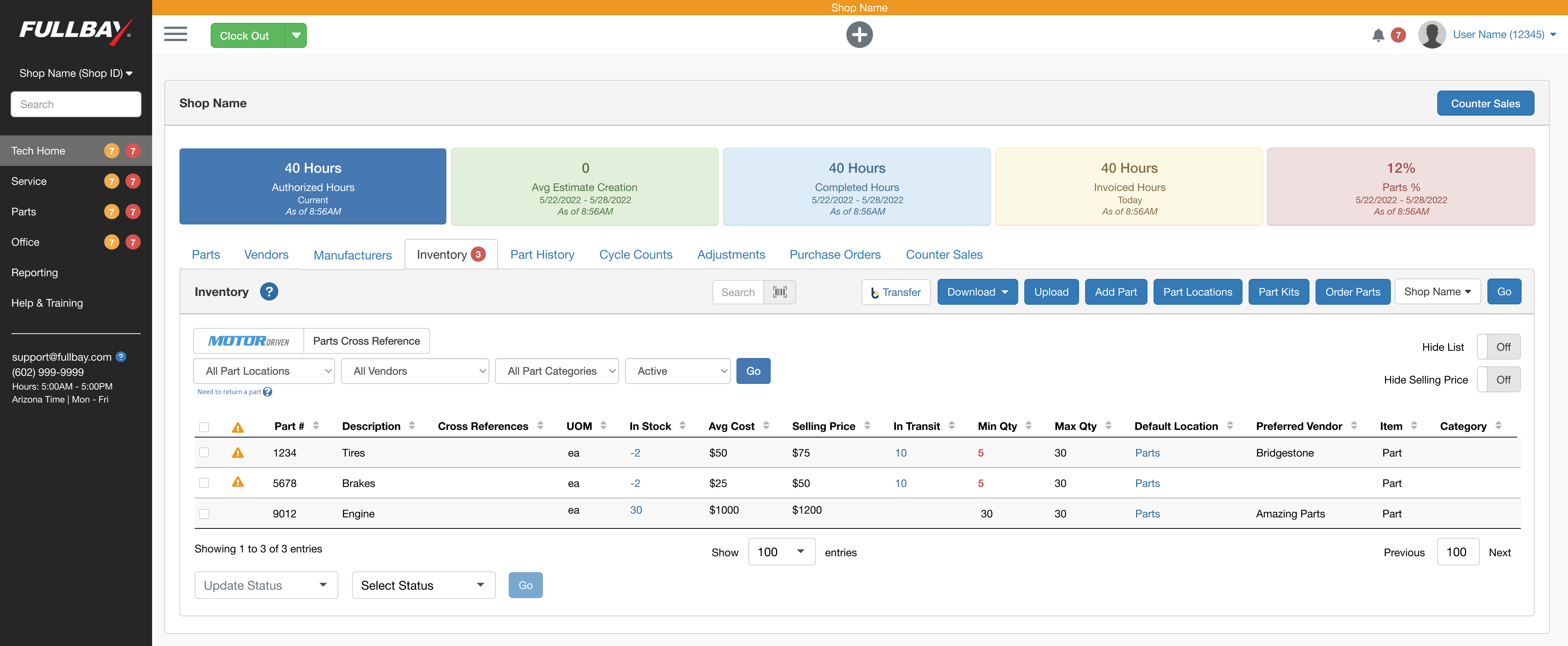
Before
While establishing an entry point for the marketplace, our research revealed that low engagement was partially driven by decision fatigue and a lack of clarity around the feature’s purpose. To address this, we streamlined the user journey to create a more focused, intentional experience that clearly communicates the value and use of this section of the app.
Marketplace V2
Taking a holistic approach, the redesign surfaced the marketplace’s true potential—better aligning with technicians’ real-world shopping and quoting behaviors while supporting Fullbay’s expansion into tire shops and adjacent markets.
expanding fitment (repair Match)
Creating a more natural workflow for technicians
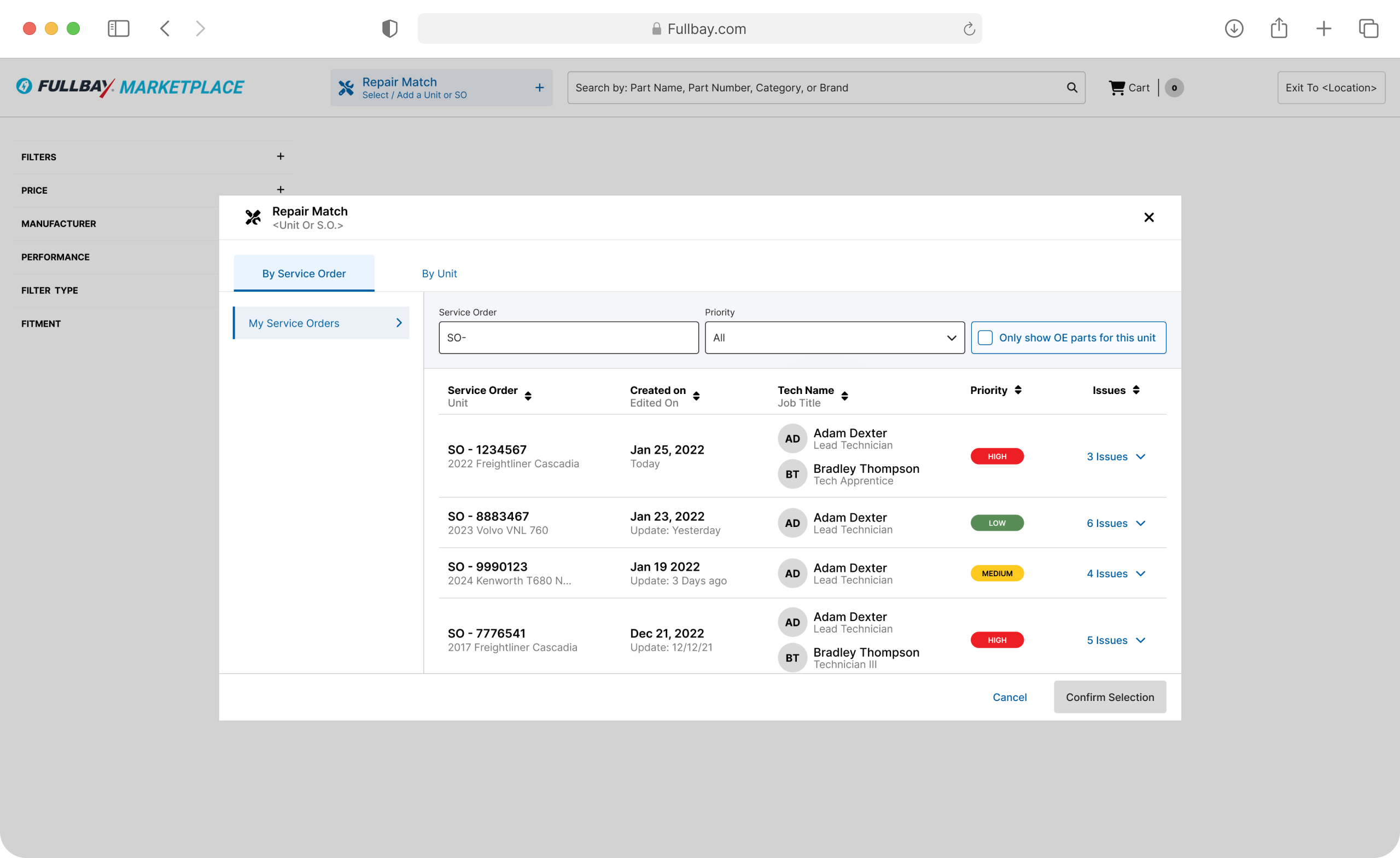
Expanding fitment to include service orders aligns with how mechanics actually work, since they think in terms of the job at hand rather than just part numbers. It speeds up part location, reduces errors, and ensures only parts that fit both the vehicle and the repair are shown.
Expanding options when quoting for a specific unit
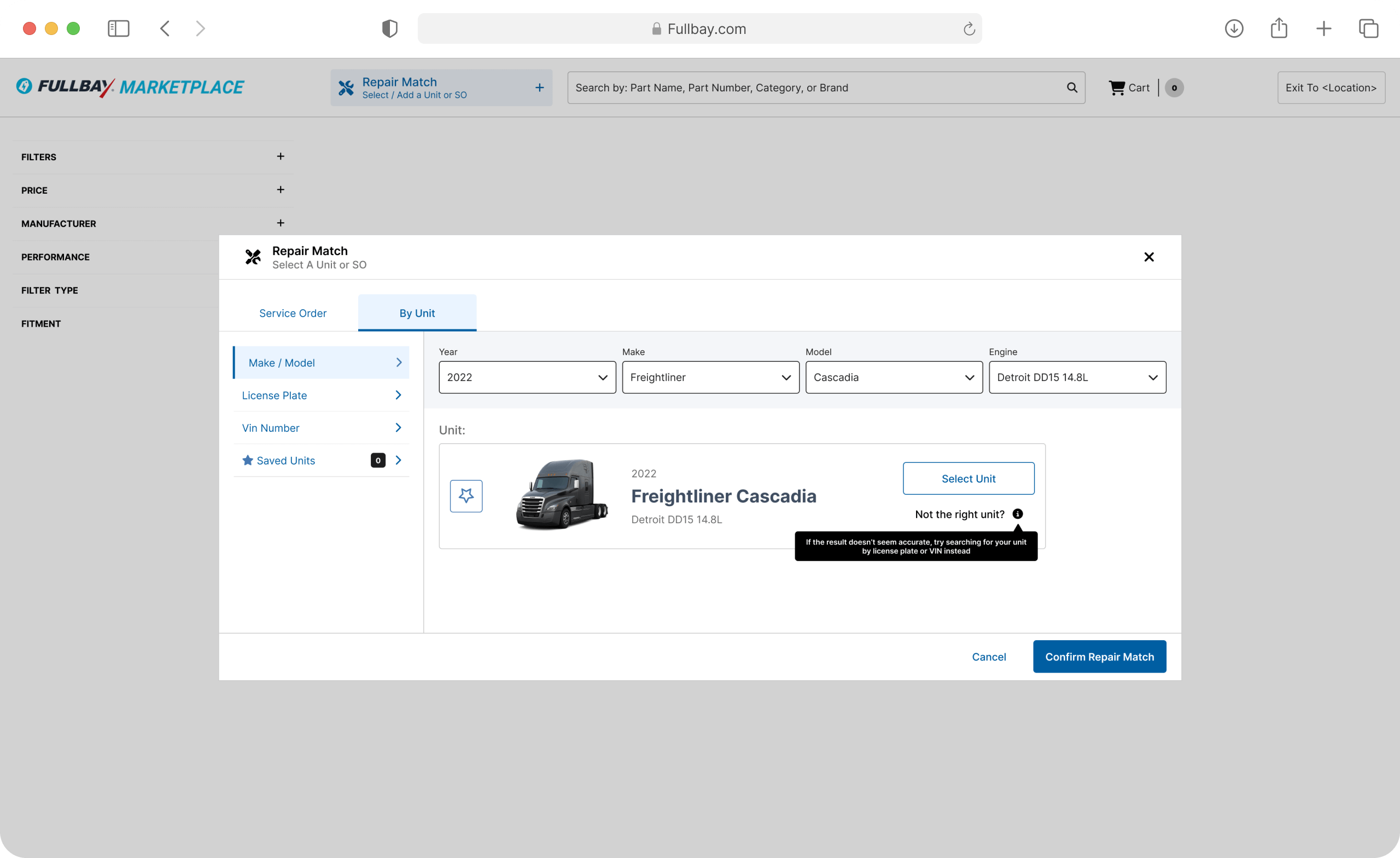
To match the speed and flexibility of online retailers, we added alternative unit search methods—license plate and VIN—when technicians quote parts outside of a service order.
Cross-referencing parts
More part options to choose from

By leveraging the existing API functionality of Fullbay’s sole marketplace partner, we surfaced cross-reference parts during quoting—supporting more accurate decision-making and reinforcing trust between shops and customers through transparent, fair pricing.
More transparent quoting
Minimizes any surprises that arise when communicating with customers
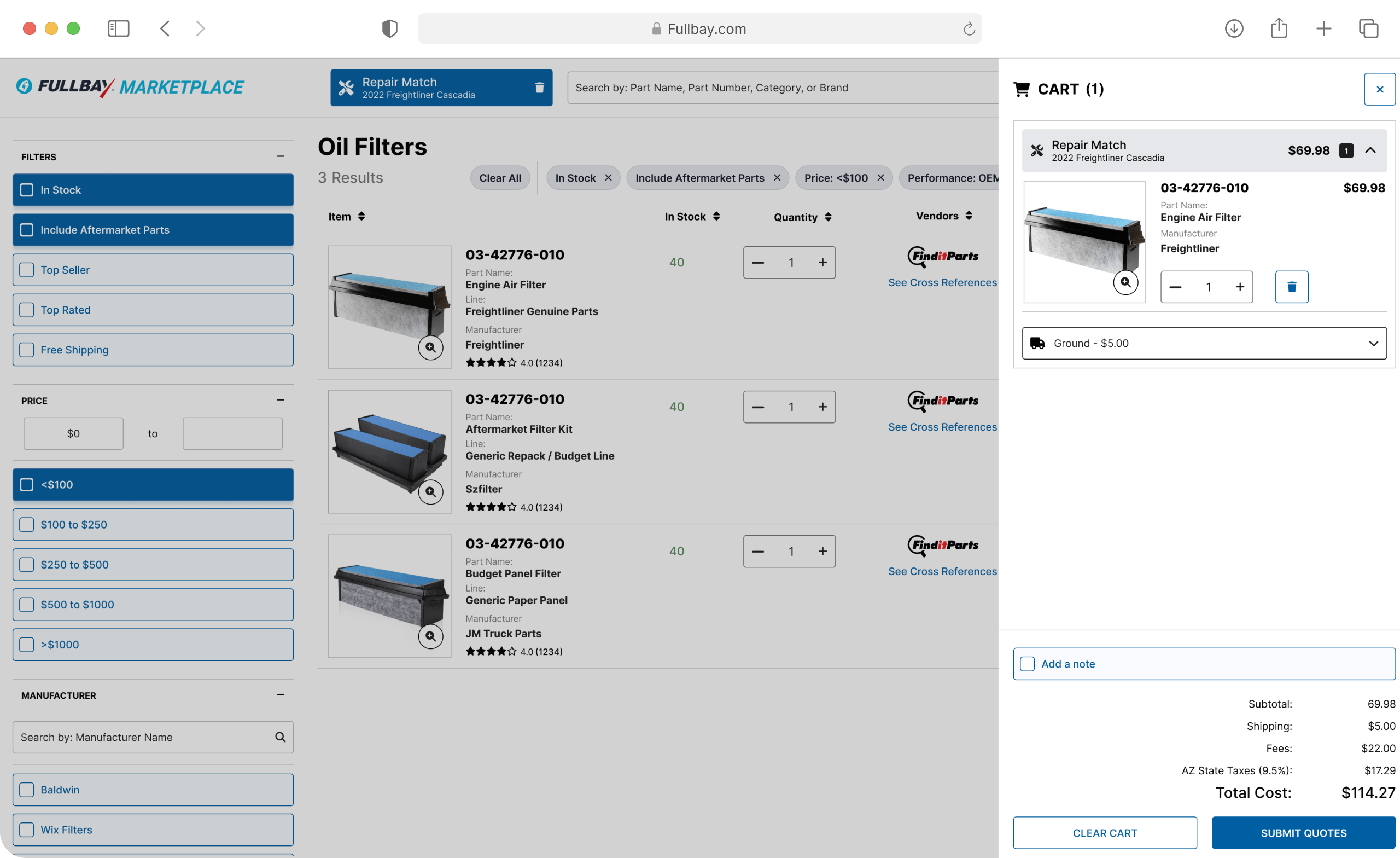
Early in the research phase, we identified that a major pain point for technicians was providing accurate estimates for part repairs. By showing the majority of costs upfront, we enabled them to speak more confidently with customers and build trust by being transparent.
The New Marketplace User flow
First-Time Use
Use Case: A technician accesses the Marketplace for the first time through the Inventory entry point. They use Repair Match to identify a unit and proceed through the shopping experience to successfully quote a part.
Results
The Marketplace Was Hidden No More
While I was confident in the direction of the work, the outcome surpassed expectations. The redesign transformed the marketplace from a deprioritized feature into a core, roadmap-worthy initiative and a central focus for the team to continue driving sustained impact.
Business related
Metric: Revenue Generated
.5% / $15K
Initial Metric
15% / $450K
60-Days Post Release
30% / $900K
90-Days Post Release
user related
Metric: Customer Satisfaction
9%
Initial Metric
50%
14-Days Post Release
70%
30-Days Post Release
Post-Release
Reflection
Cross-Functional Collaboration
By approaching the Marketplace from a new perspective (Version 2), we enabled the development team to realign their tech stack, creating a foundation for more cohesive collaboration on future initiatives, starting with introducing an actual process that would expedite their ability to ship quickly and with quality code.
Business Centered
This work helped establish design as a trusted strategic function within the organization. Through best-practice execution and strong cross-functional collaboration, the marketplace gained renewed visibility and support. The narrative around the feature shifted noticeably—from cautious and dismissive to confident, intentional, and customer-forward.
The success of marketplace allowed for negotiations to not only improve the feature overtime but to seek additional opportunities to increase revenue through e-commerce within the app.