talent infusion
Invite To Apply (V1)
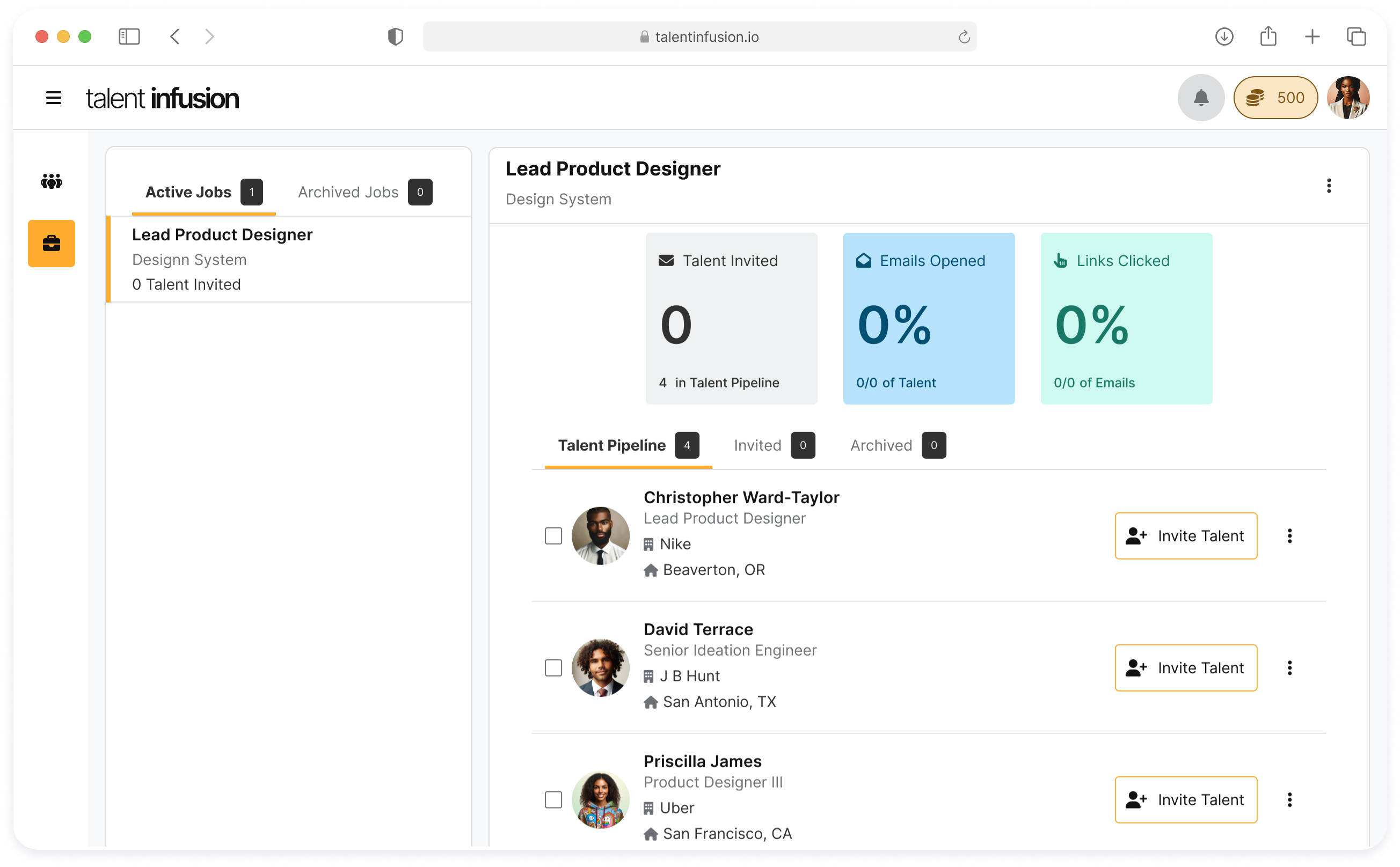
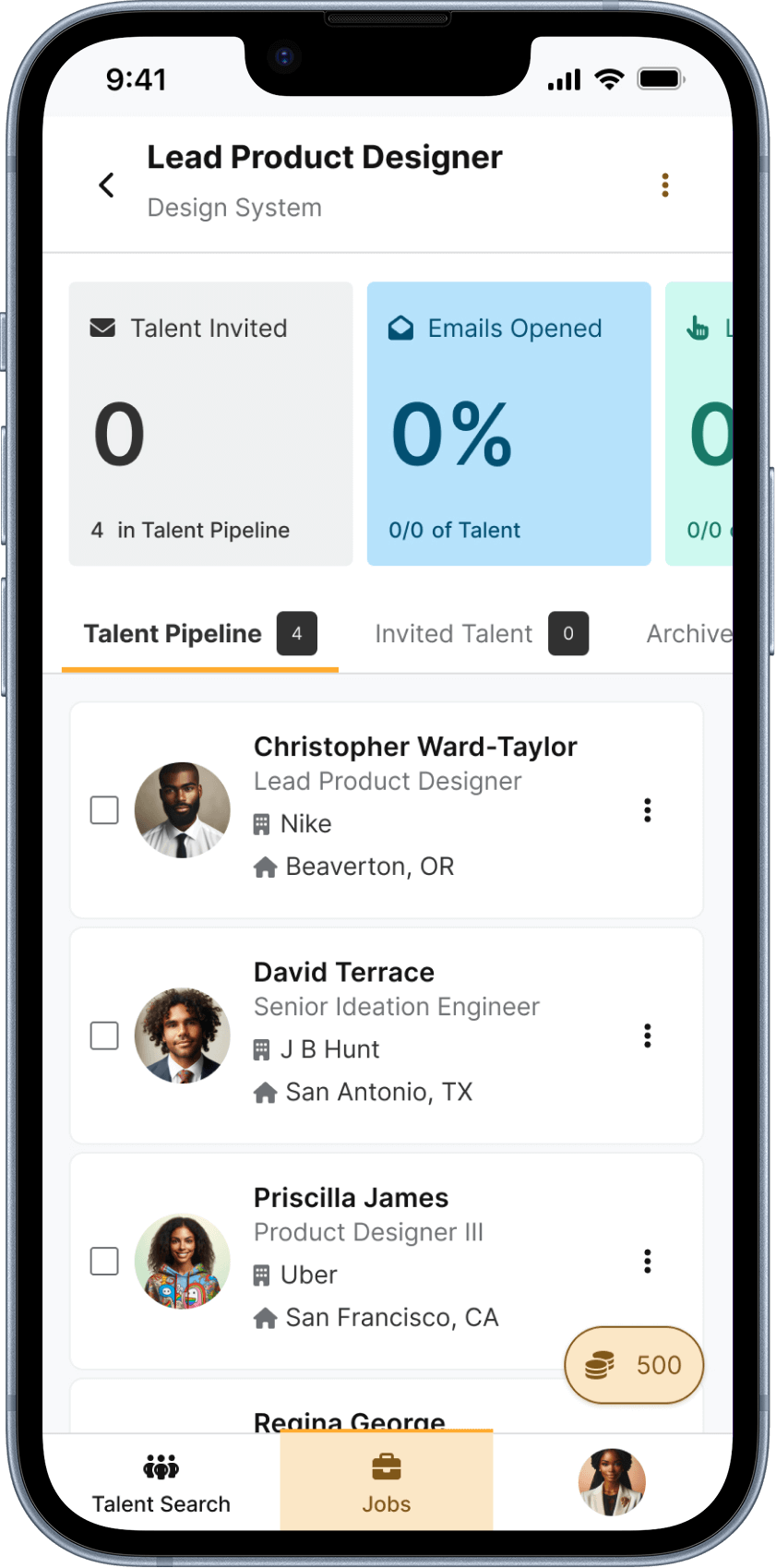
AI-Enhanced Process
0→1 Project
Responsive Web
iOS
Streamlining Outreach, Amplifying Impact
Blavity's physical Talent Infusion book connected underrepresented tech talent with employers at AfroTech annually, but couldn't scale beyond one event per year. I led the 0-to-1 design strategy to transform this into a year-round digital platform, which resulted in 770% user growth within the first 18-months, and 70% repeat usage within the first 30-days of launch.
year
2024
Company
Talent Infusion
Role
Lead Product Designer
Project Duration
6 Sprints
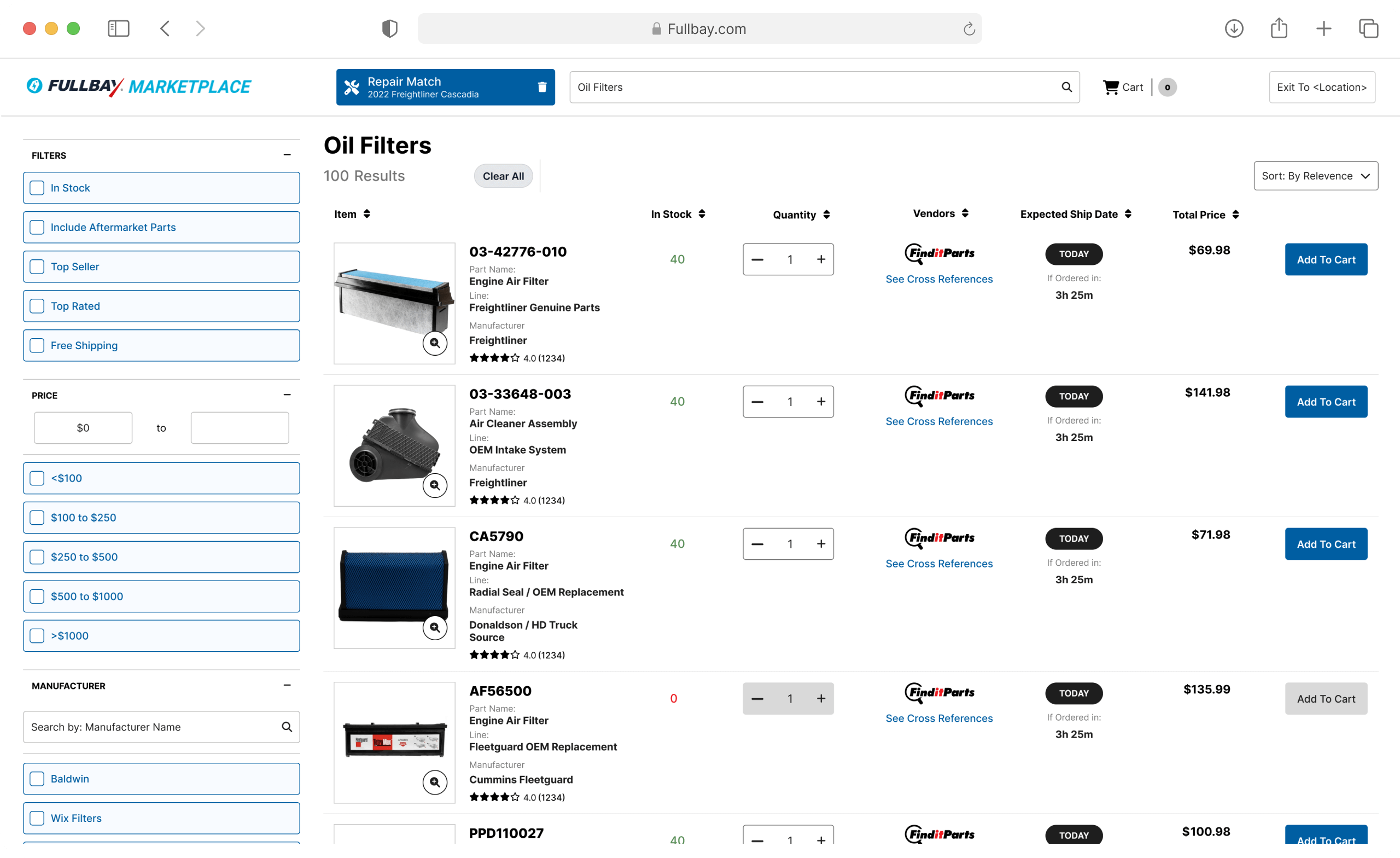
Video output of the clickable prototype used during testing to show the user's experience of creating a job for the first time on desktop. (Including the edge cases of No Search Results and where an takent profile has already been invited to job"
PRIMARY OBJECTIVES
What Did We Set Out to Achieve?
Talent Infusion was seeking to establish itself in a market that was already oversaturated. We didnt want to create just another talent search tool but to harness the effectiveness of AfroTech year-round in getting more talented individuals noticed (and subsequently hired) by some of the top organizations in the world. With this in mind, we cant the primary objectives light at first.
business related
What was the primary business opportunity for this project?
Create adoption that will validate product-market fit, drive platform stickiness, and create the foundation for future feature expansion and customer retention.
Goal(s): 60% adoption, 70% repeat usage within 30 days
User related
In what way did we want to improve the overall user experience
Enable fast, high-volume talent outreach by allowing users to invite multiple candidates at once.
Goal: 60% of invitations sent in batches of 5+ candidates.
PRIMARY CONSTRAINTS
What Were Some of the Blockers We Needed to Consider?
The idea of this project was groundbreaking fortheorganization was groundbreaking, but in practice, we needs to take into account that there needed to be a foundation built around it to garner success.
Talent Infusion in its digital form lack identity
Traditionally, corporate sponsors attending AfroTech received a physical binder of résumés from attendees seeking consideration for tech roles. After the conference’s seventh year, its parent company, Blavity, decided to evolve this process into a digital platform—not only to serve conference attendees, but to expand its reach to both companies and tech professionals more broadly.
At the time, there was still no clear direction on where this experience should ultimately live. While a web-based application offered the fastest path to market, a native app was also being explored, with early technical efforts underway to assess its viability.

The proof-of-concept for Talent Infusion only included search functionality with the ability to download resumes on a talent profile.
Mutable Team Structure
Blavity made the executive decision to transition away from full-time, in-house technical support for Talent Infusion and instead partner with a third-party offshore consulting firm. As a result, existing team and design processes quickly became ineffective. The frequent developer turnover made it difficult to onboard new engineering support while also maintaining momentum, particularly while operating as the sole designer on the team.
No Project Direction
Operating within a non-technical environment, many traditional product and design processes were absent. For this effort, there were no formal user stories in the conventional sense—only a high-level list of stakeholder-defined requirements outlining the desired outcomes.
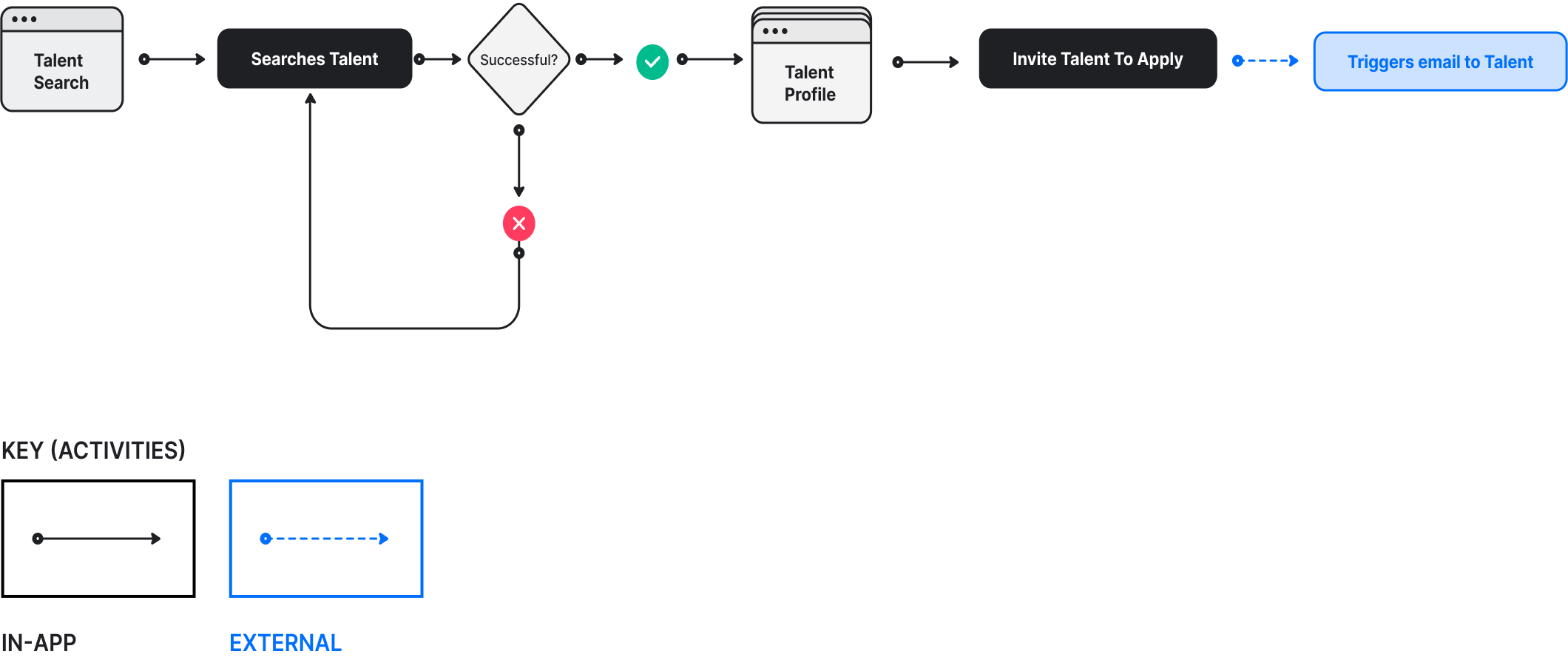
A visual representation of the original user story.
STRATEGY
Demolishing Those Blockers, Aligning For Growth
Considering that this was the companies first design effort and the flagship feature for Talent Infusion, I had to go back to basics and take the rest of the team with me.
Getting User Feedback
Working with marketing, we produced a value perception survey to be sent out to the 100 enterprise users to better understand their workflow and preferred methods of communicating with candidates during the hiring process. Here are some insights we’ve found the most interesting.
Survey Stats
How many enterprise users were contacted and how many successfully completed the survey
100
Contacted
30
Responded
Process Enhancement
How user anticipated this new feature enhances their internal processes
85%
Anticipated Process Improvement
Avg time per invite
The amount of time our users spend sending an invite to potential candidates.
10-15 min
Per Lead
painpoint
The primary painpoint users have expressed for using this feature.
47%
Cited anticipated ATS integration
process satisfaction
How pleased our users are with their current process
67%
Avg. Approval Rating
Create The User Story
While this may seem to be working backwards, I wanted to identify and present to the team if and how this effort was perceived to be successful (or even useful) before Identifying the "Why".
The new user story
The new direction we wanted to take the Invite To Apply effort
“As an enterprise user, I want to invite selected talent members to apply for specific job openings in my ATS/CRM So that I can engage qualified candidates and track their application journey from invitation to application and beyond”

Introducing AI into the project process
As sole designer on a cross-functional team, I facilitated strategic prioritization that aligned engineering, product, and business stakeholders on must-have features vs. future iterations. Used structured design exercises such as AI-assisted collaborative sessions to surface edge cases, elevate design considerations among non-designers, and build shared ownership of product quality.
This collaborative approach enabled us to launch MVP within the provided timeframe with core features rather than building everything slowly. The focus on high-impact features drove our rapid user growth while building lasting design literacy across the team.


Before
After
Example how how we used LLMs to help streamline ideas discovered by the team during brainstorming into a formidable plan for the team to consider.
I also led the use of LLMs to help non-designers present and define their ideas for presentation. By doing this, it set a level-playing field for everyone who may have been intimidated or lacked confidence in their ability to participate in producing design output at a strategic level. We then used those outputs to validate and challenge our ideas.
HMW: Make the invitation process efficient and prove its value so the feature is used consistently
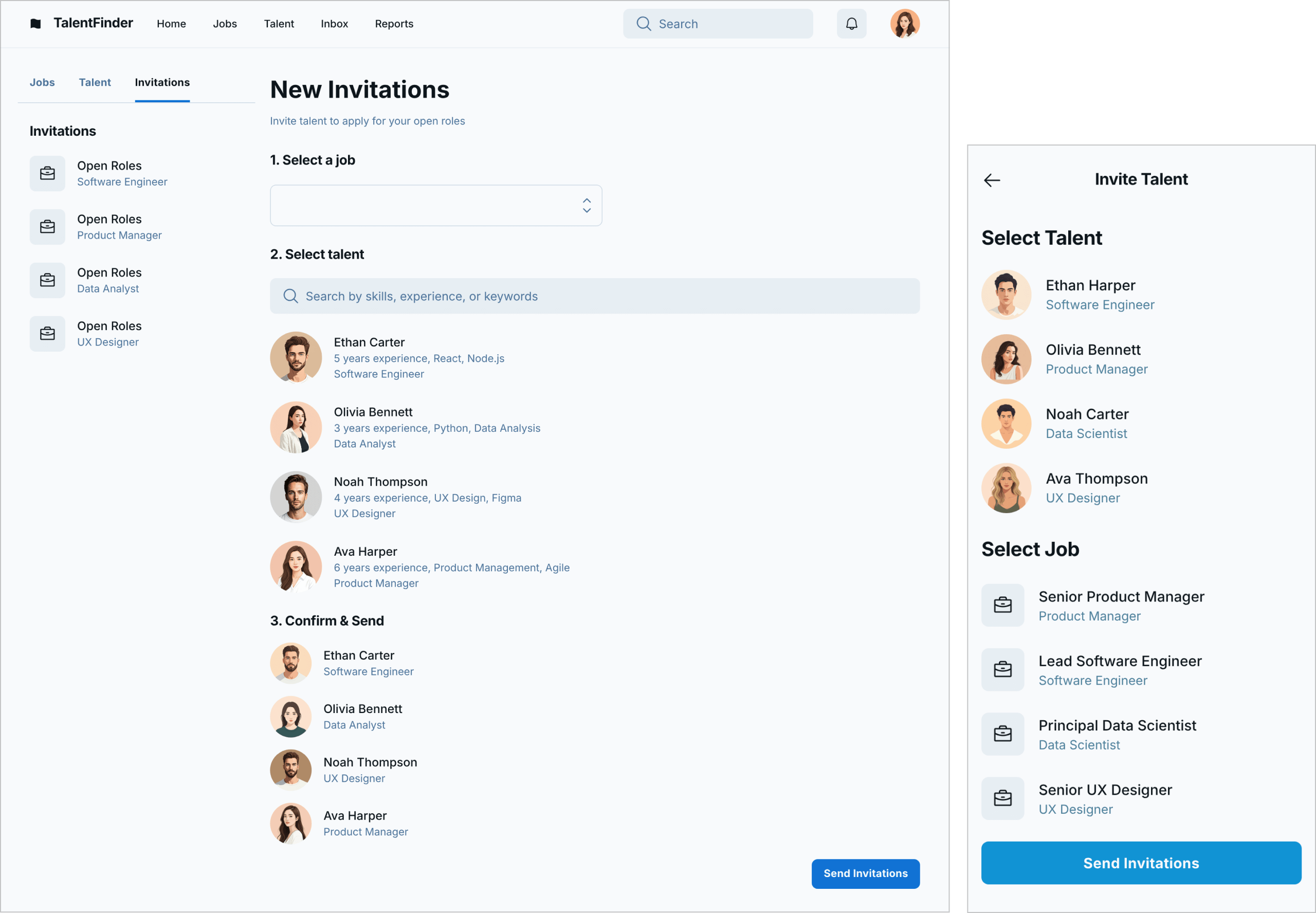
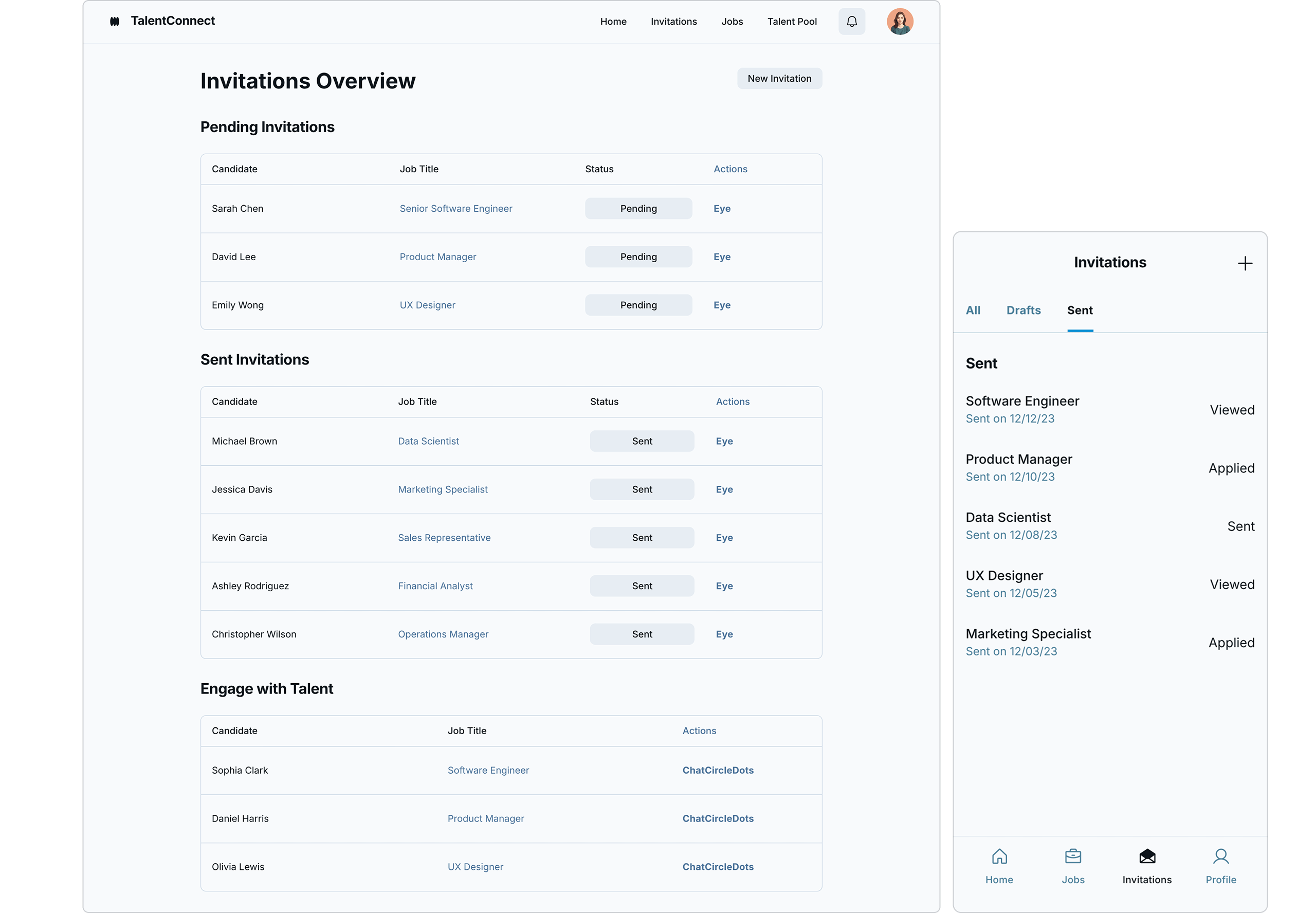
Adjusting the prompt to introduce the concept of status and how it could be used in the design solution
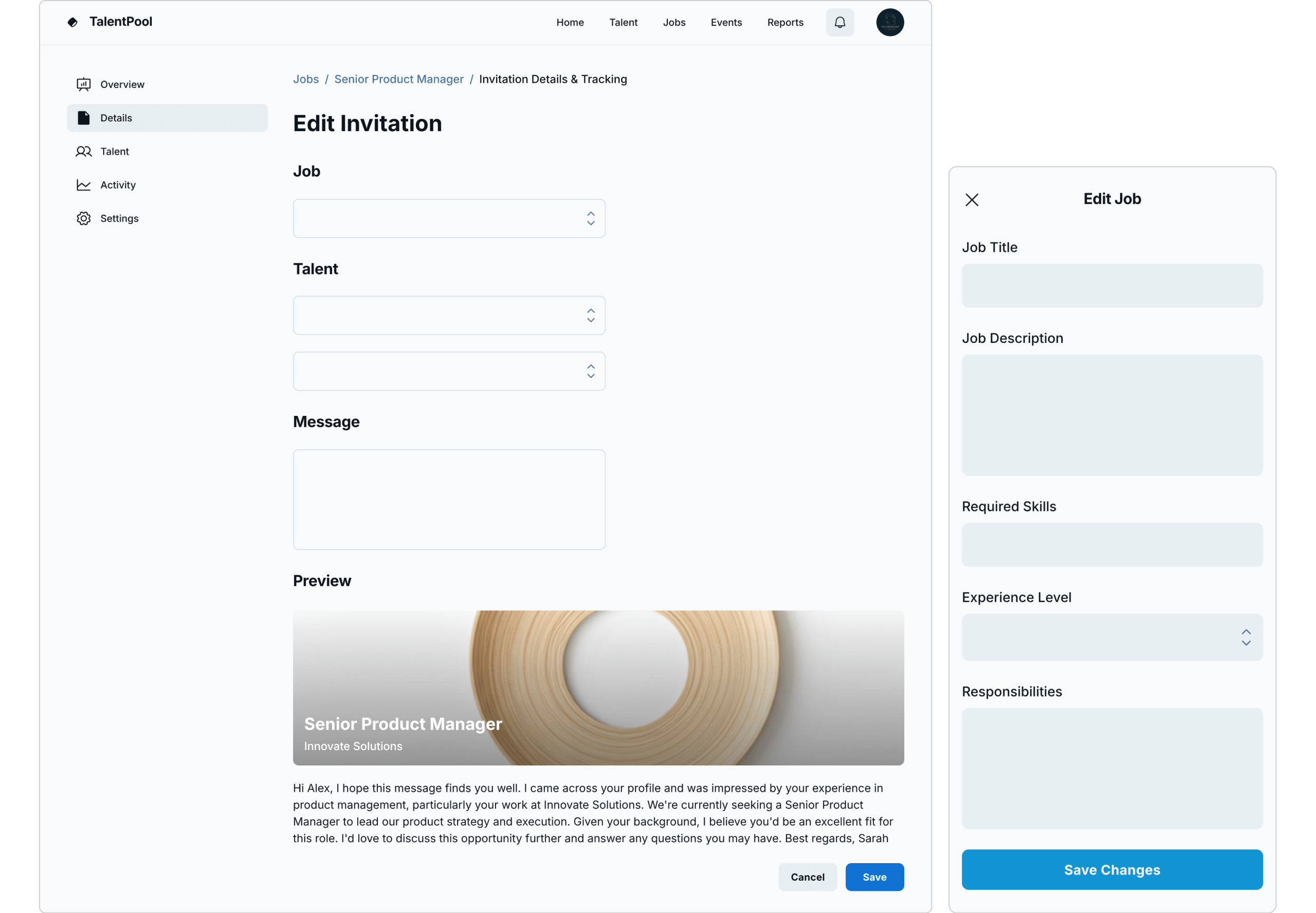
Addressing error handling via editting a created job
Establishing Primary Success Metrics
The team then decided to map out success metrics for the project using the HEART framework (Google) and Goal-Signal-Metric framework as guides, modifying them both to better align with Talent Infusion. While we were able to identify 10, the following were the ones centering either design or overall product.
enterprise User growth (First 3-Months)
How was this measured? How often was it tracked
100%
200 Active Users
(Active User Count pre-feature) X 2
Tracked: Weekly
If Successful (>100%)
Identify power users and analyze their behavior with the feature to document their workflow. Work with sales to create case studies for new customers.
If needs improvement (<100%)
Investigate friction points and drop-offs, create/improve feedback loop with customers to investigate dissatisfaction
Repeat Usage Rate (First 30-days)
How was this measured? How often was it tracked
60%
60 of 100 Active Users
(# of Users Who Sent 2+ Invitations / # of Users Who Sent ≥1 Invitation) × 100
Tracked: Weekly
If Successful (>100%)
Identify power users and analyze their behavior with the feature to document their workflow. Work with sales to create case studies for new customers.
If needs improvement (<100%)
Investigate friction points and drop-offs, create/improve feedback loop with customers to investigate dissatisfaction
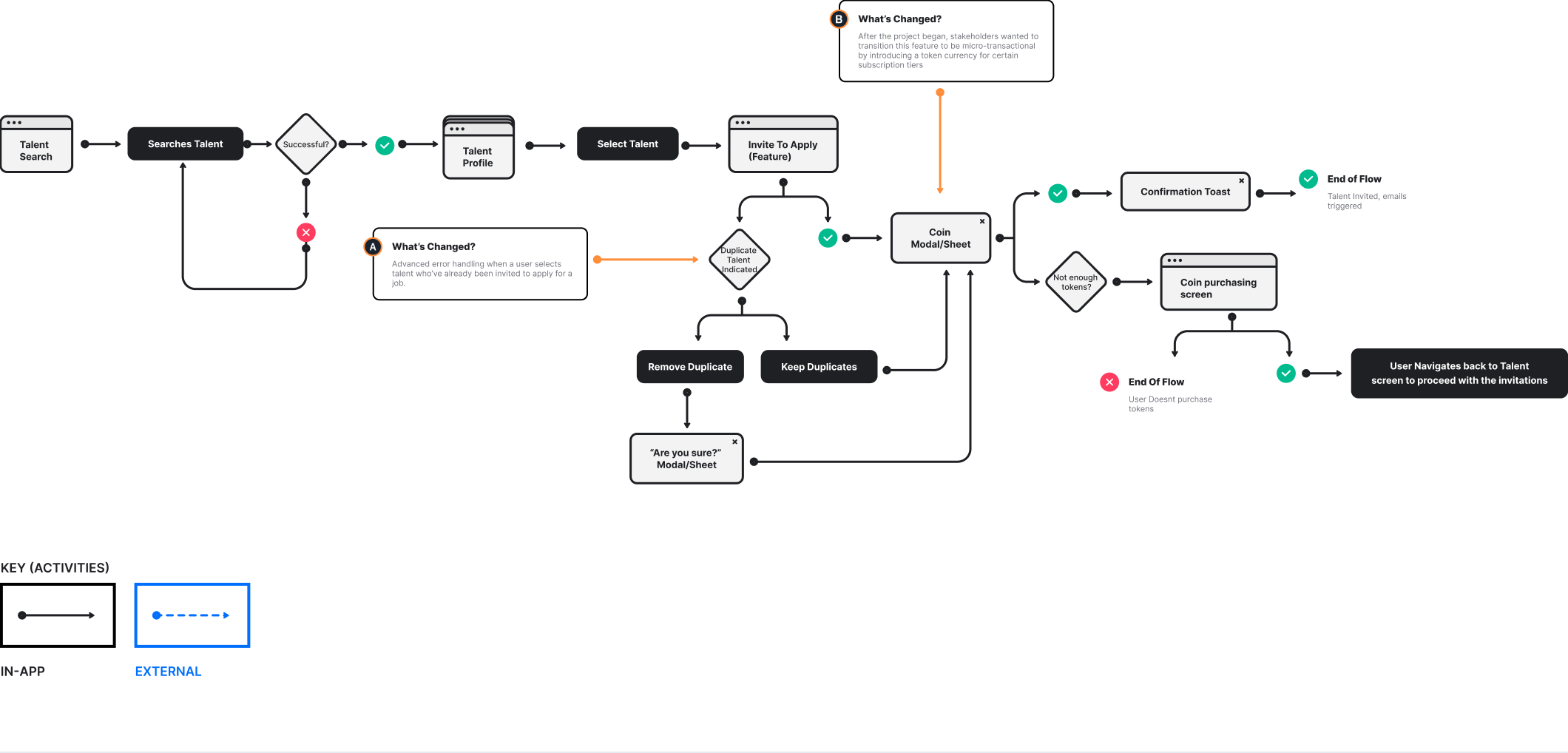
The New Primary User Flow
I was then able to identity a primary user flow with the research and information we've gathered to begin designing out a final solution to test and build.
EXECUTION
The New Path Forward
Designed experiences that enabled recruiters to find and invite diverse candidates 67% faster while ensuring underrepresented talent gained visibility based on skills, not pedigree.
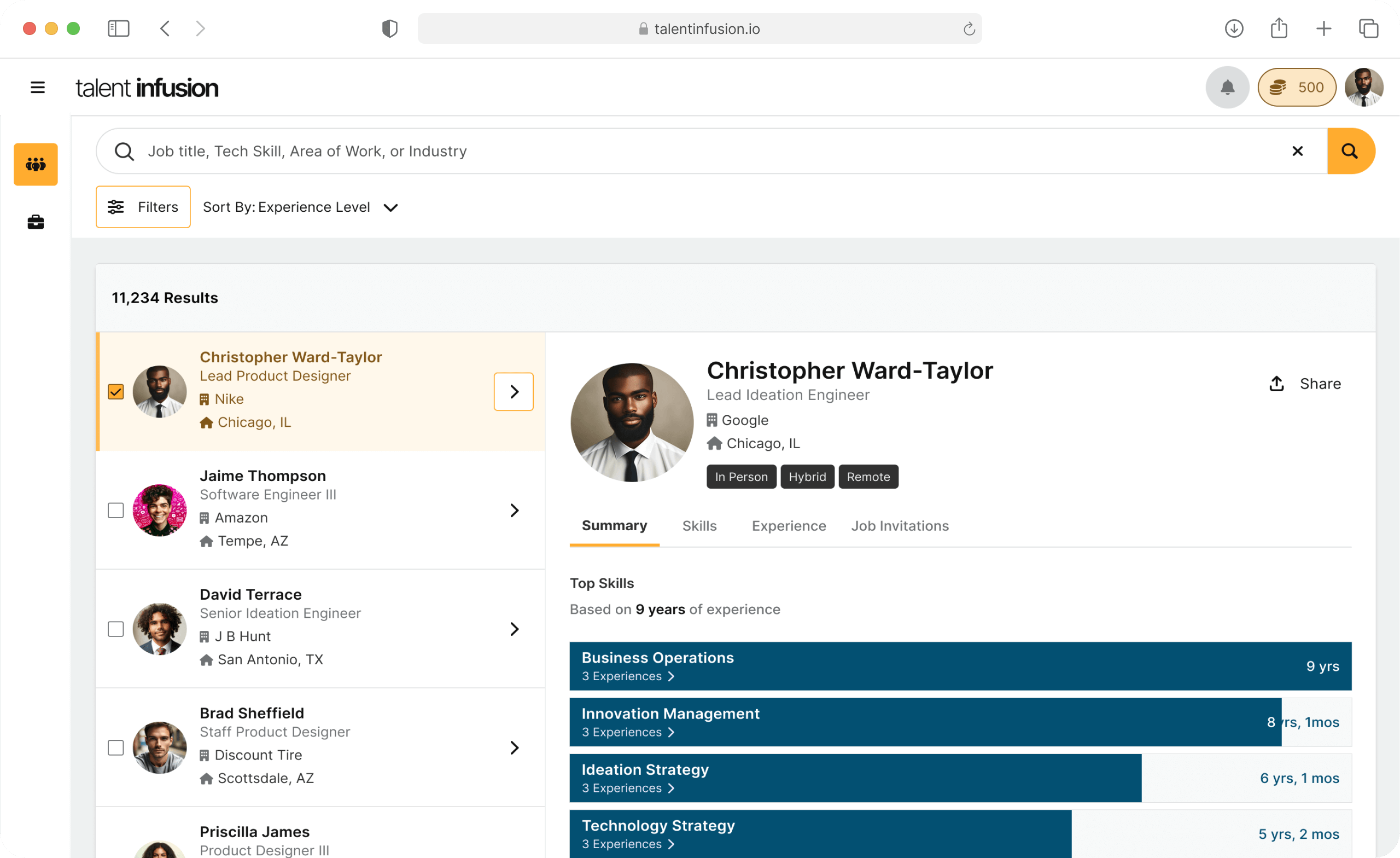
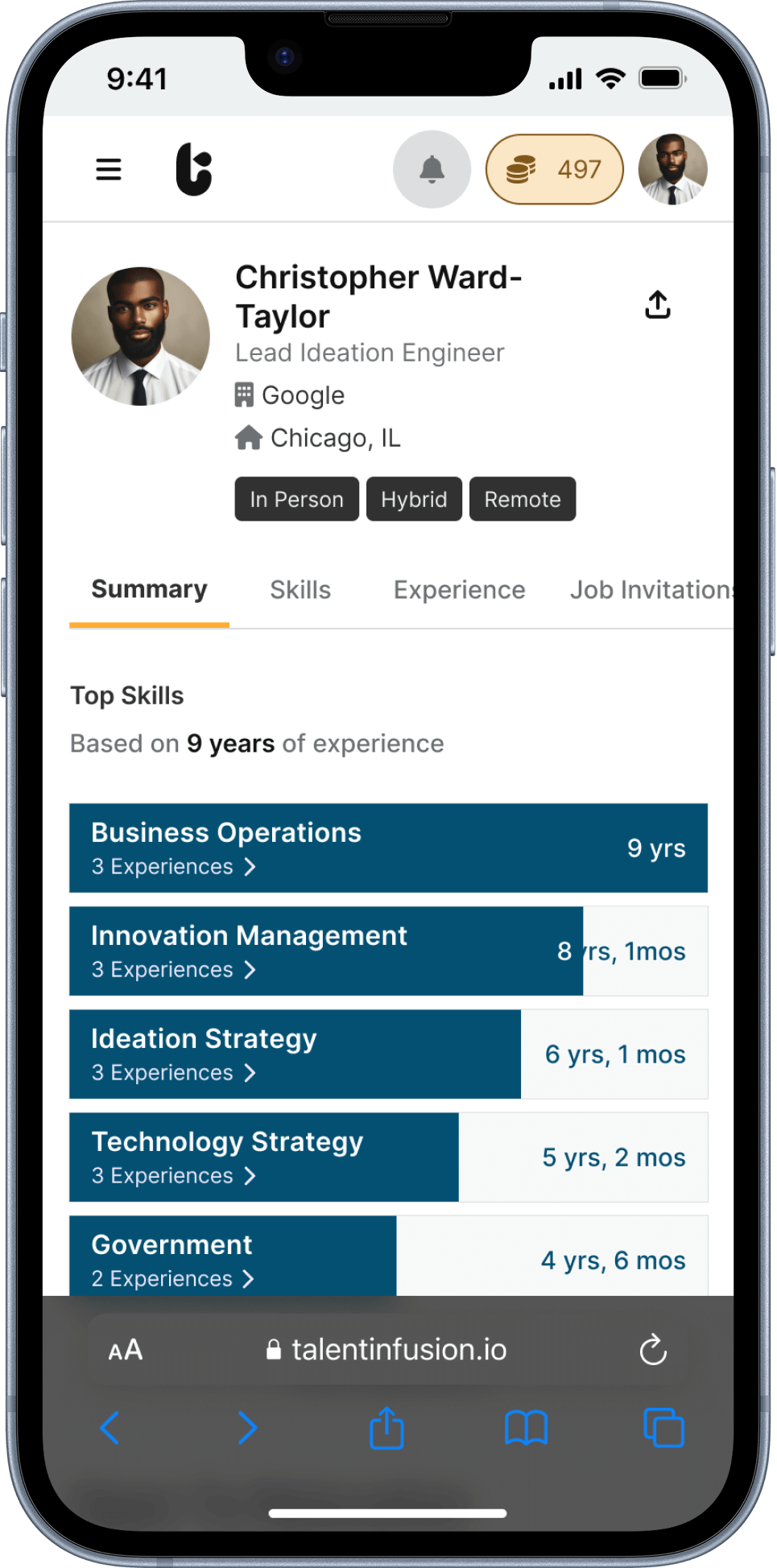
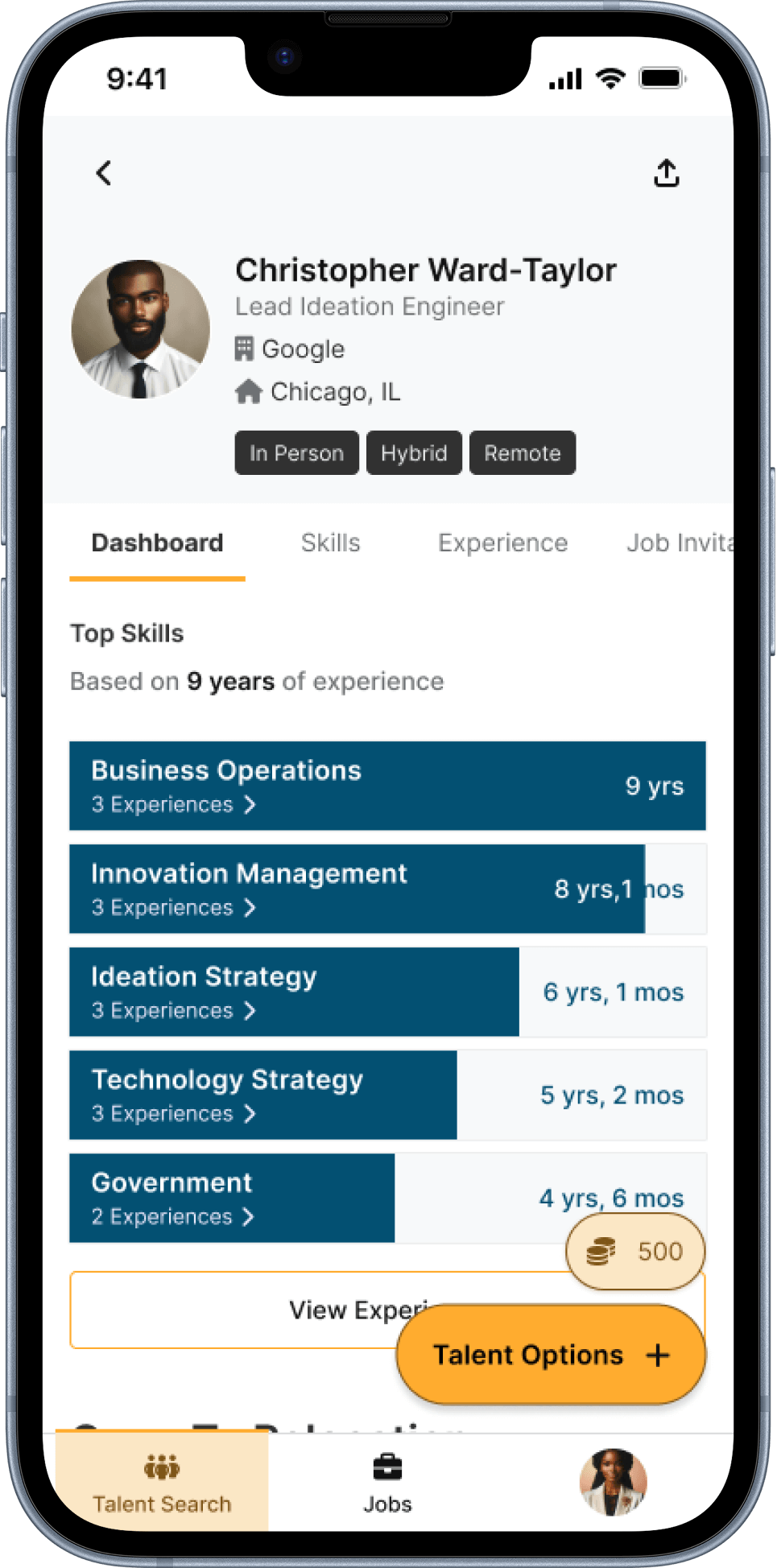
Talent Profiles
By intentionally surfacing information important to recruiting like skills, location and current job title we not only mitigate biases one may have about a potential candidate but made the vetting process much quicker.
Mobile
Native Consideration
new job creation > Job Module
Scenario: Enterprise user engages with the “Invite To Apply” feature for the first time via the “Jobs” module and creates their first active job
Mobile
Native Consideration
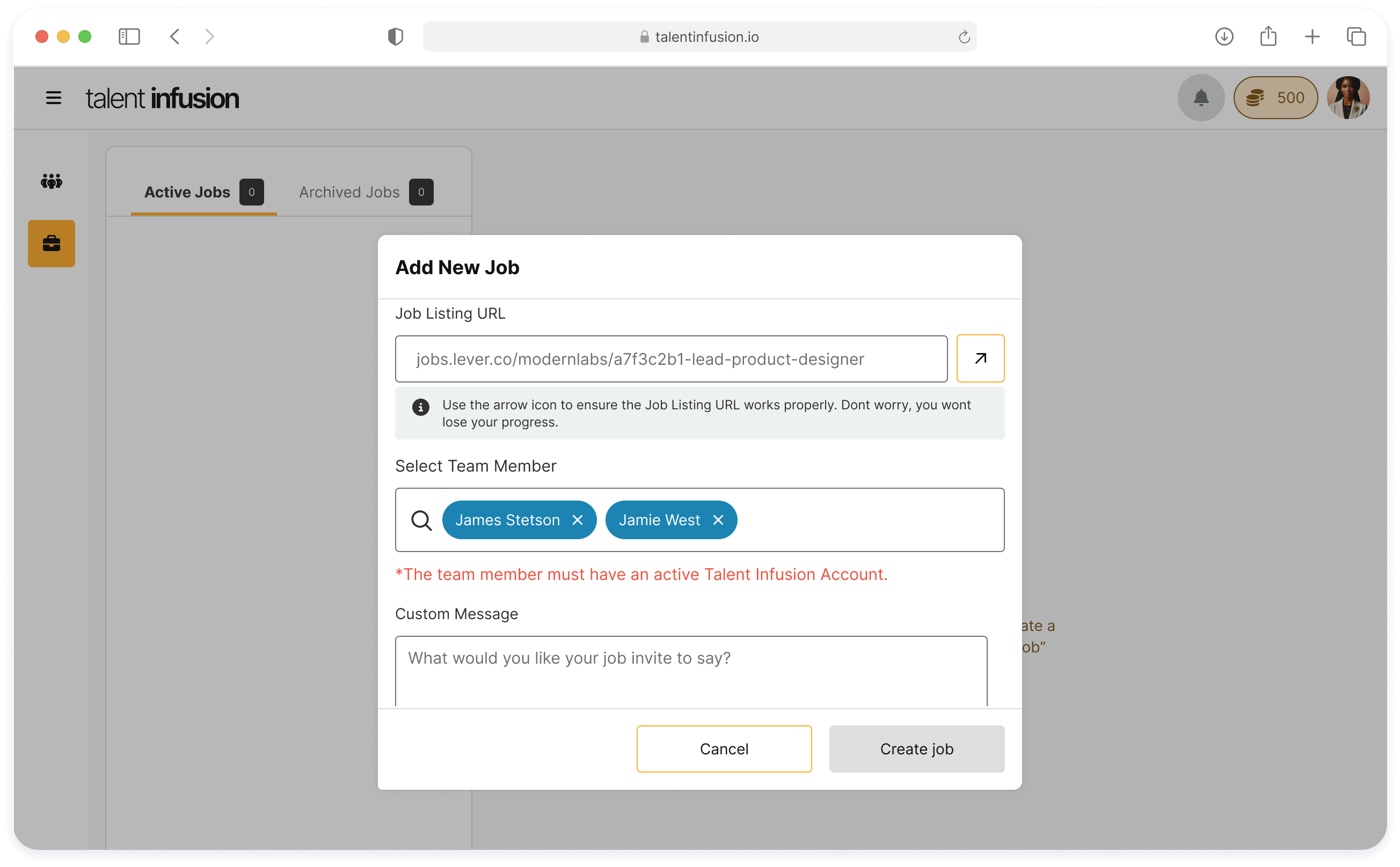
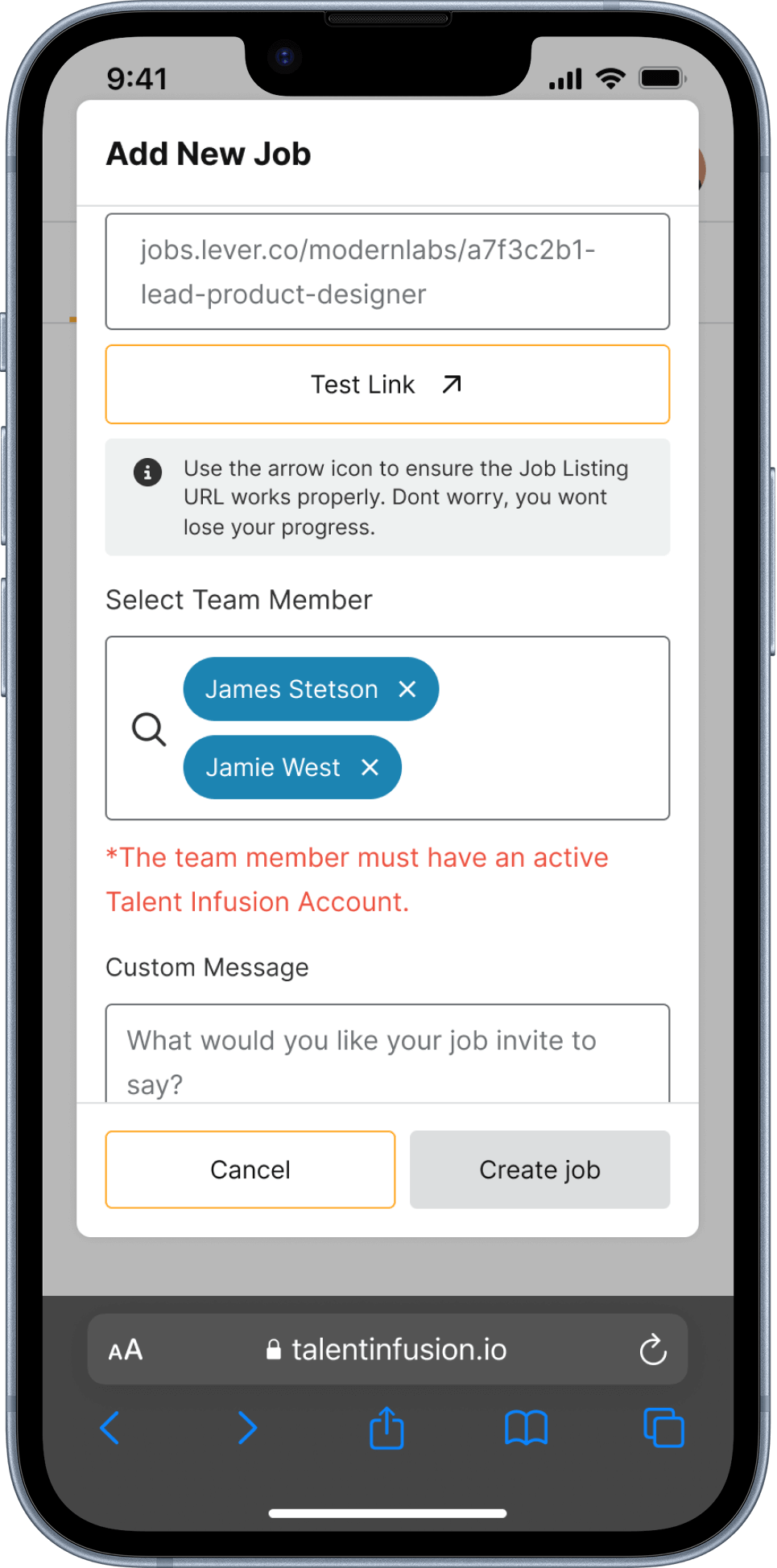
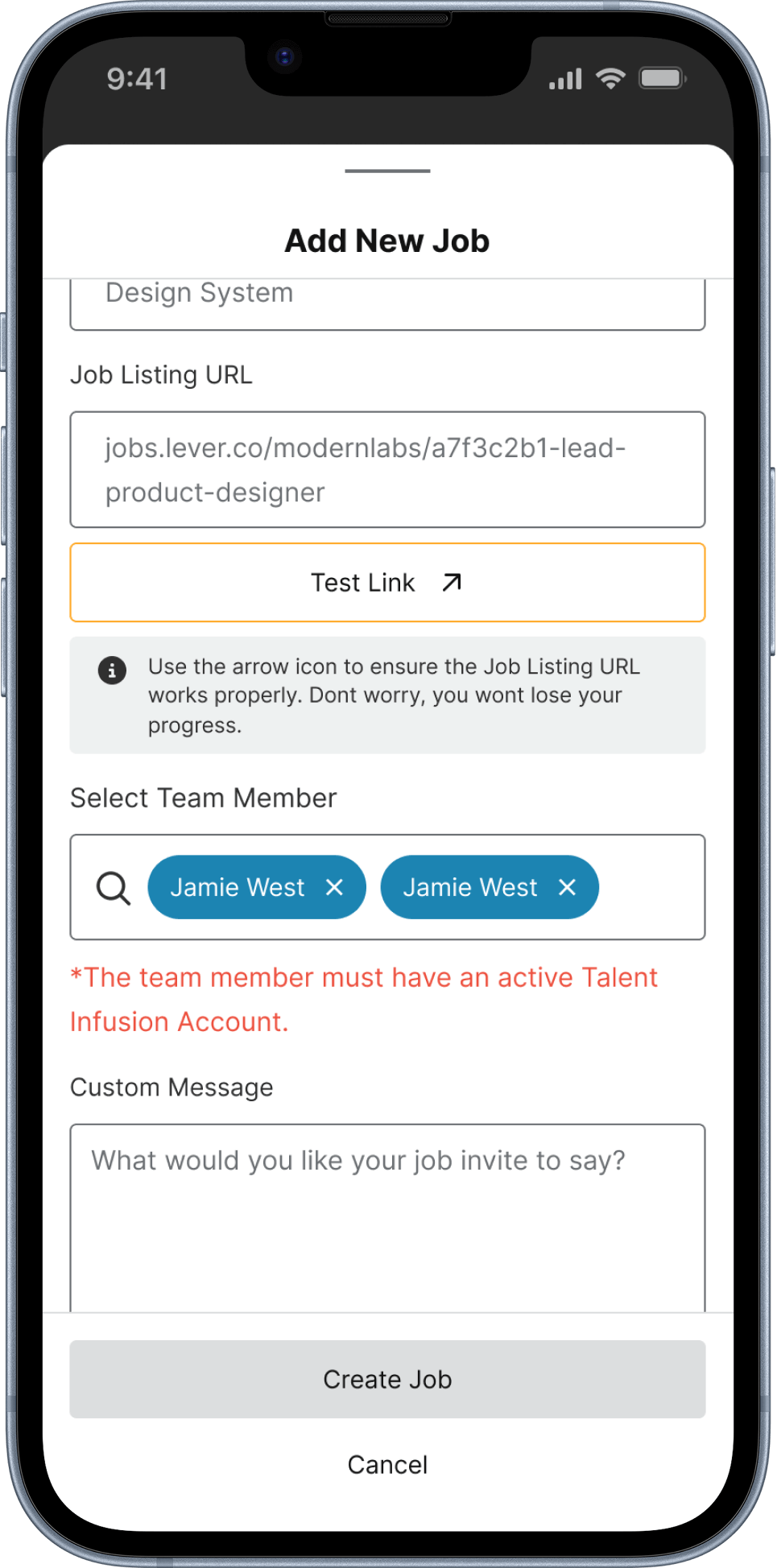
Edge Case(s)
Use Case: The enterprise user is creating a new job but is either collaborating on the recruitment effort or is doing so on behalf of another enterprise user.
Mobile
Native Consideration
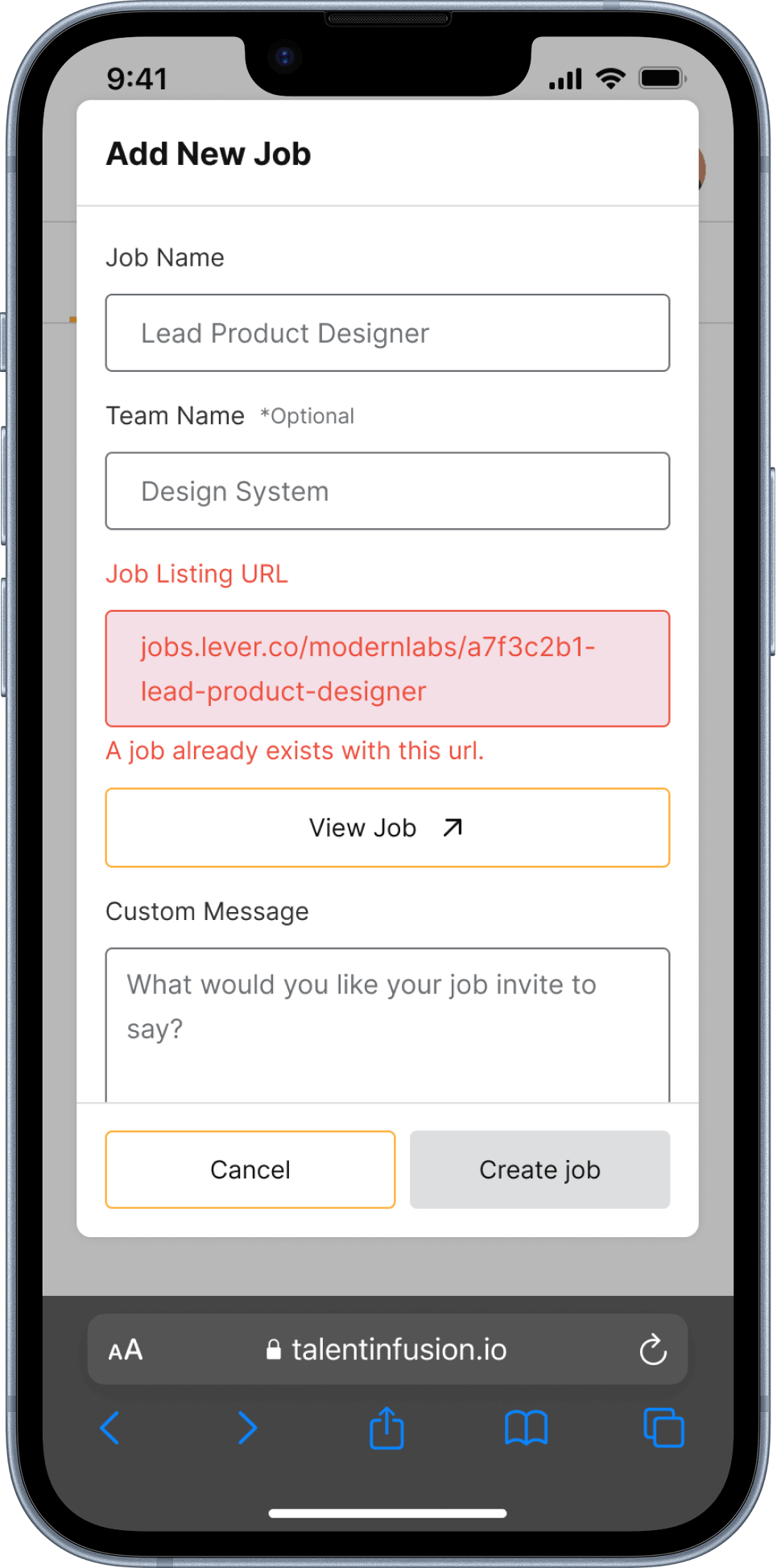
Use Case: Enterprise user is attempting to create a job but has input a URL already linked to an exisiting job (either active or archived)

Mobile
Native Consideration
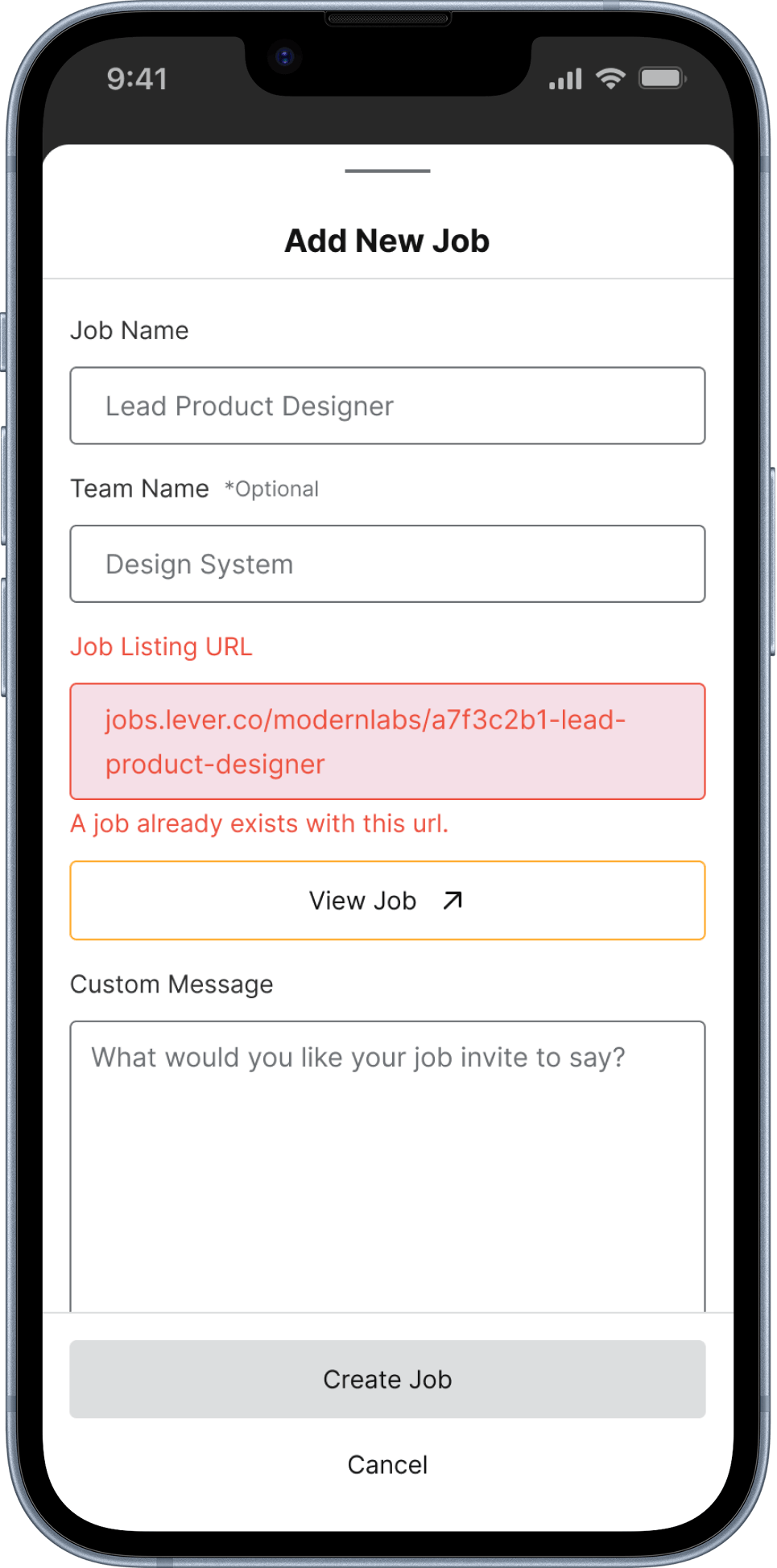
Leveraging the existing OpenAI API from the app’s onboarding flow, we aimed to prevent duplicate job postings by introducing a hard stop whenever a user attempts to add a URL tied to an existing job. We tested multiple link variations of the same job for tracking parameters when job URLS are either: shortened URLs, or part campaign-tagged links that directed to the same destination to ensure accuracy.
new job creation > Talent Profile
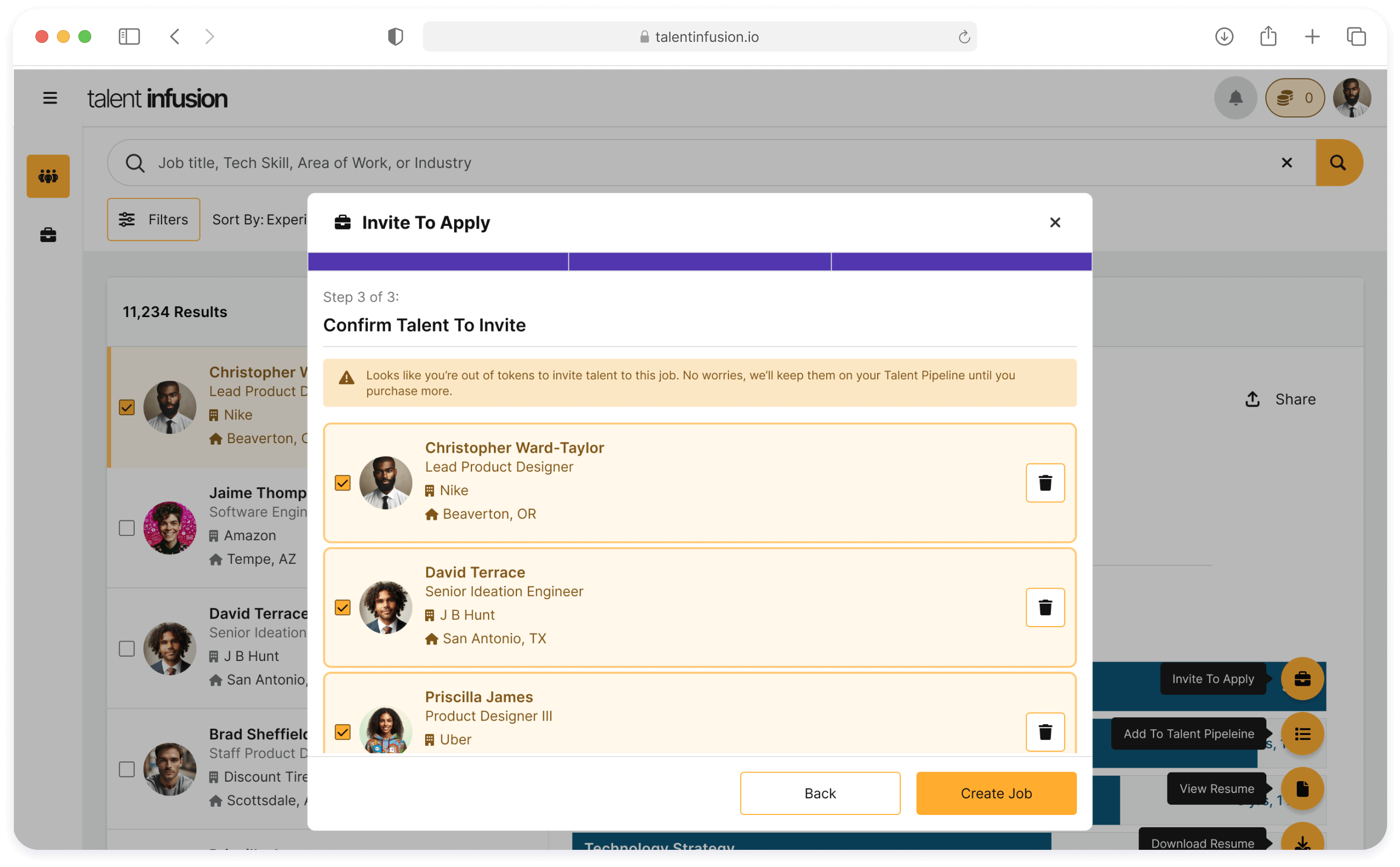
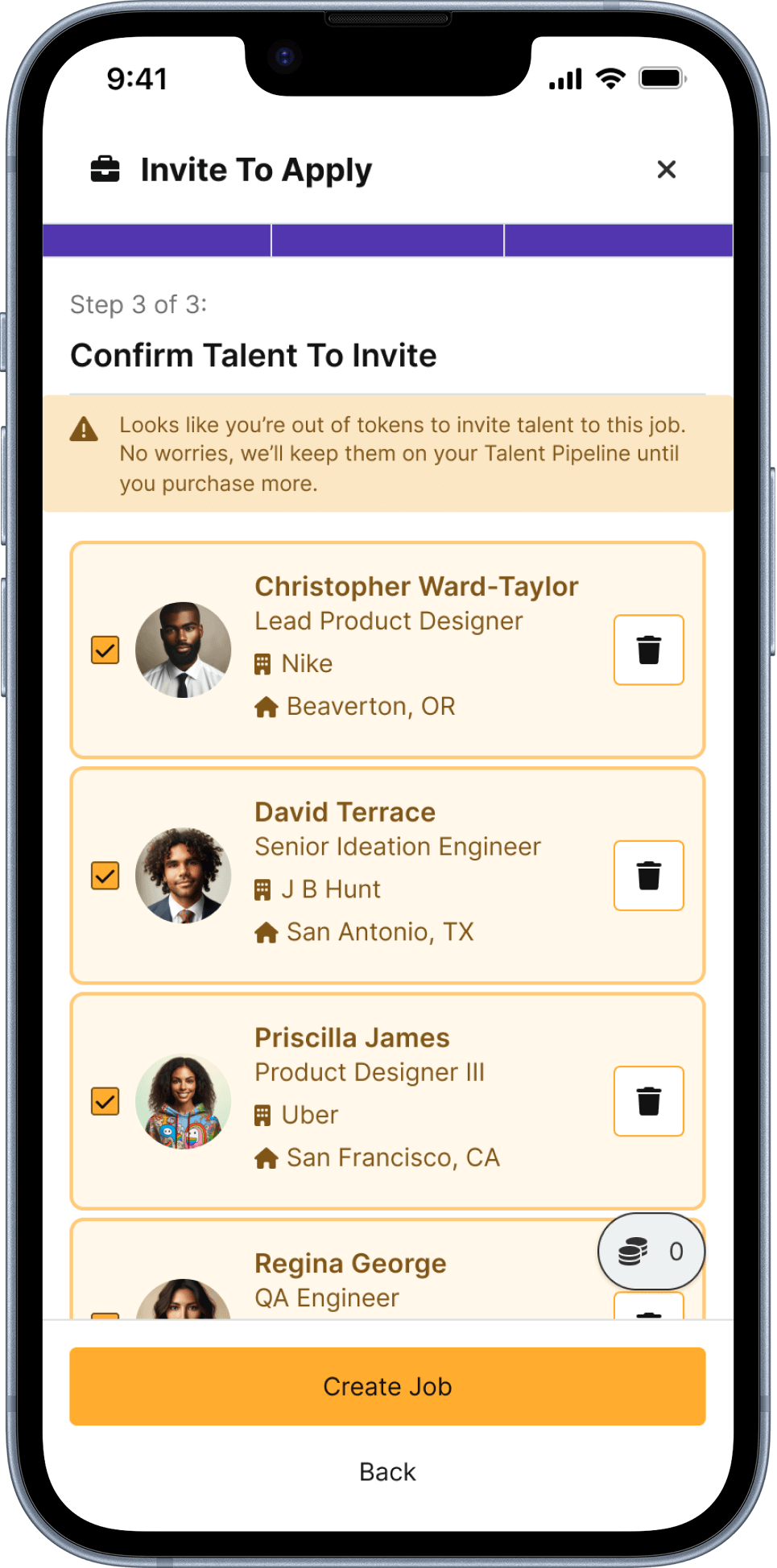
Scenario: Enterprise user engages with the “Invite To Apply” feature for the first time by selecting talent then creating their first active job
Mobile
Native Consideration
Edge Case(s)
Use Case: The enterprise user is creating a new job but has limited tokens and cant successfully invite all of the selected talent
Mobile

Native Consideration
Inviting Talent > Jobs module
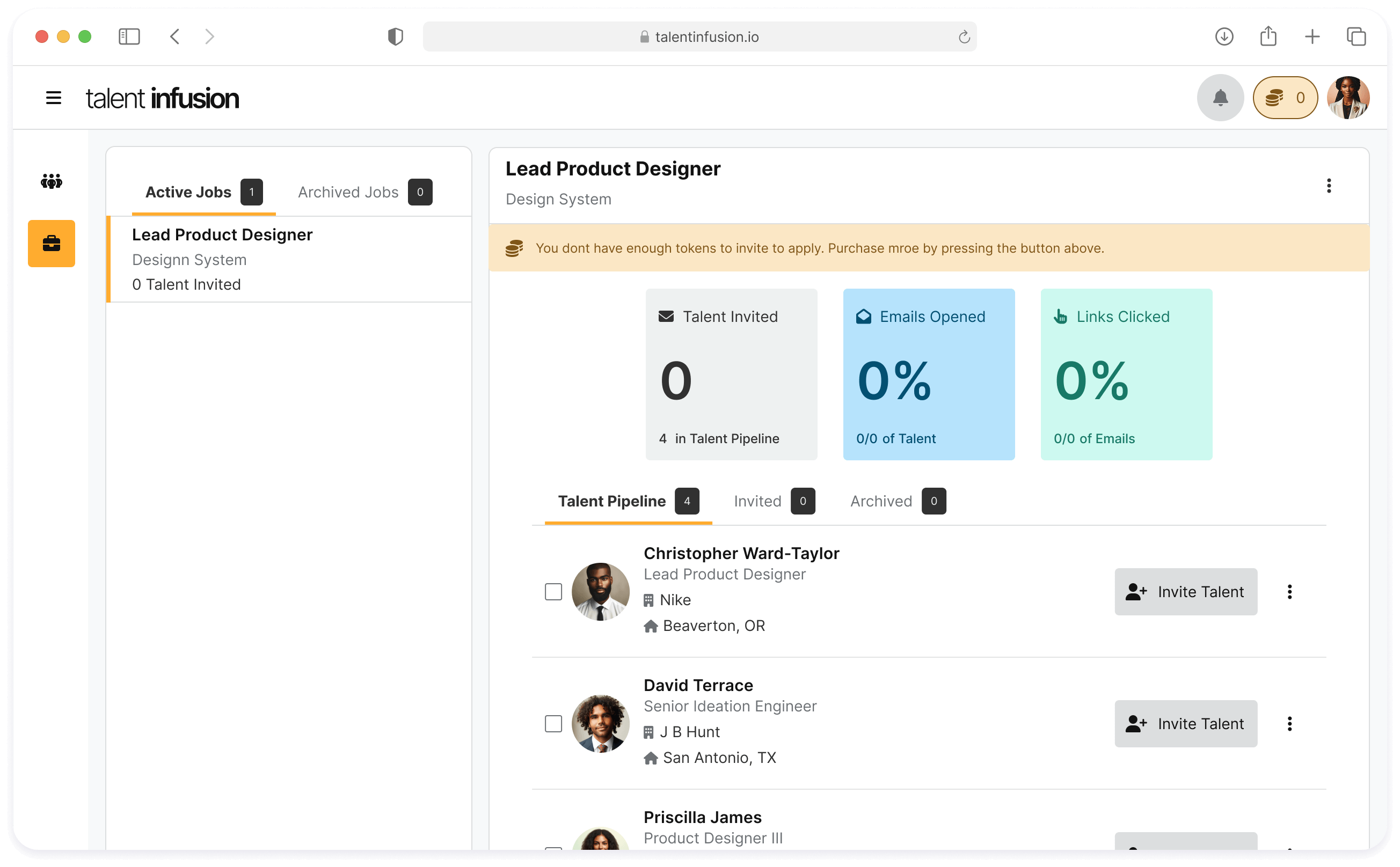
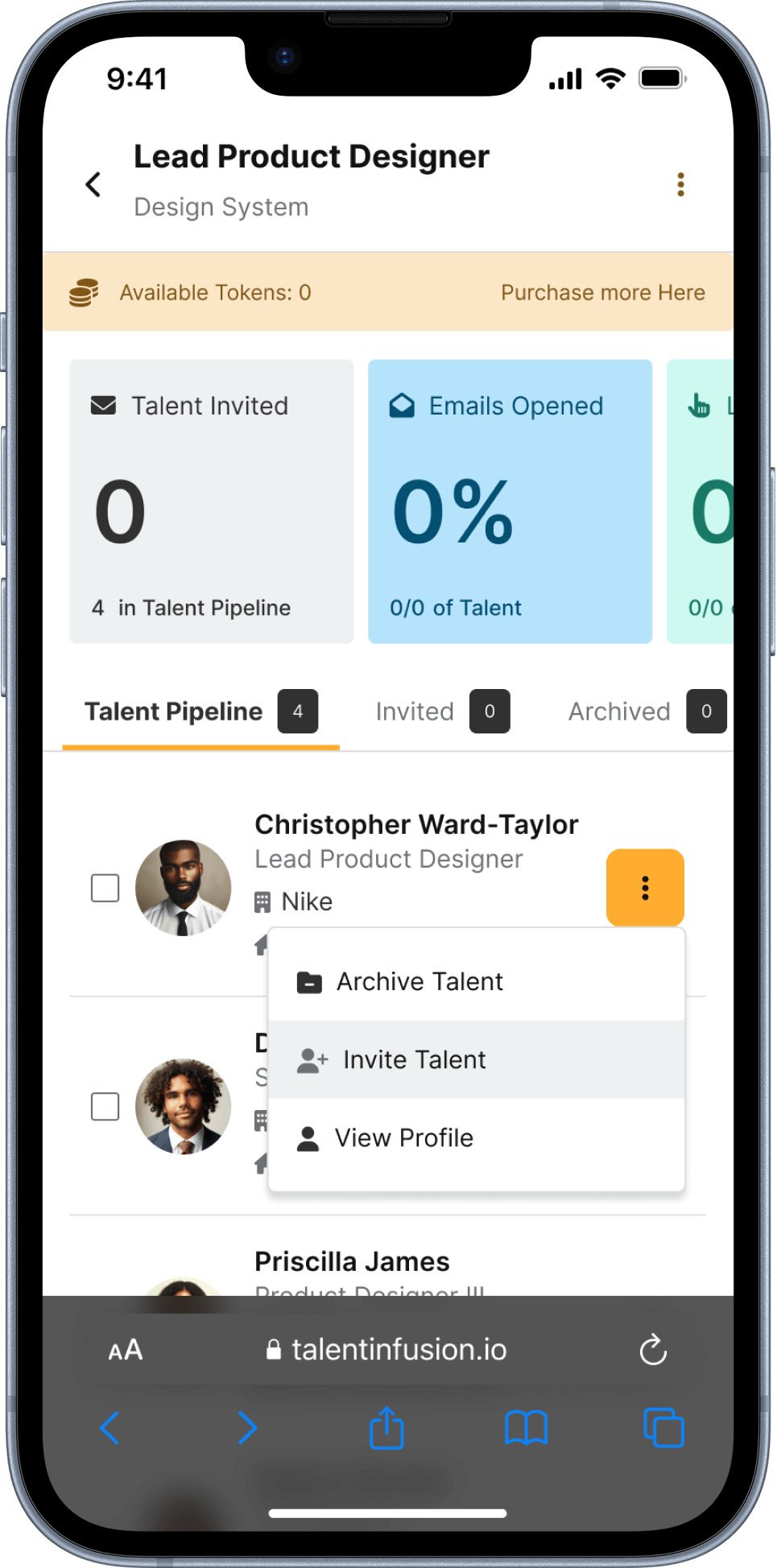
Scenario: Enterprise user selects talent from the “talent pipeline” within a job then proceeds to invite them to an active job
Mobile
Native Consideration
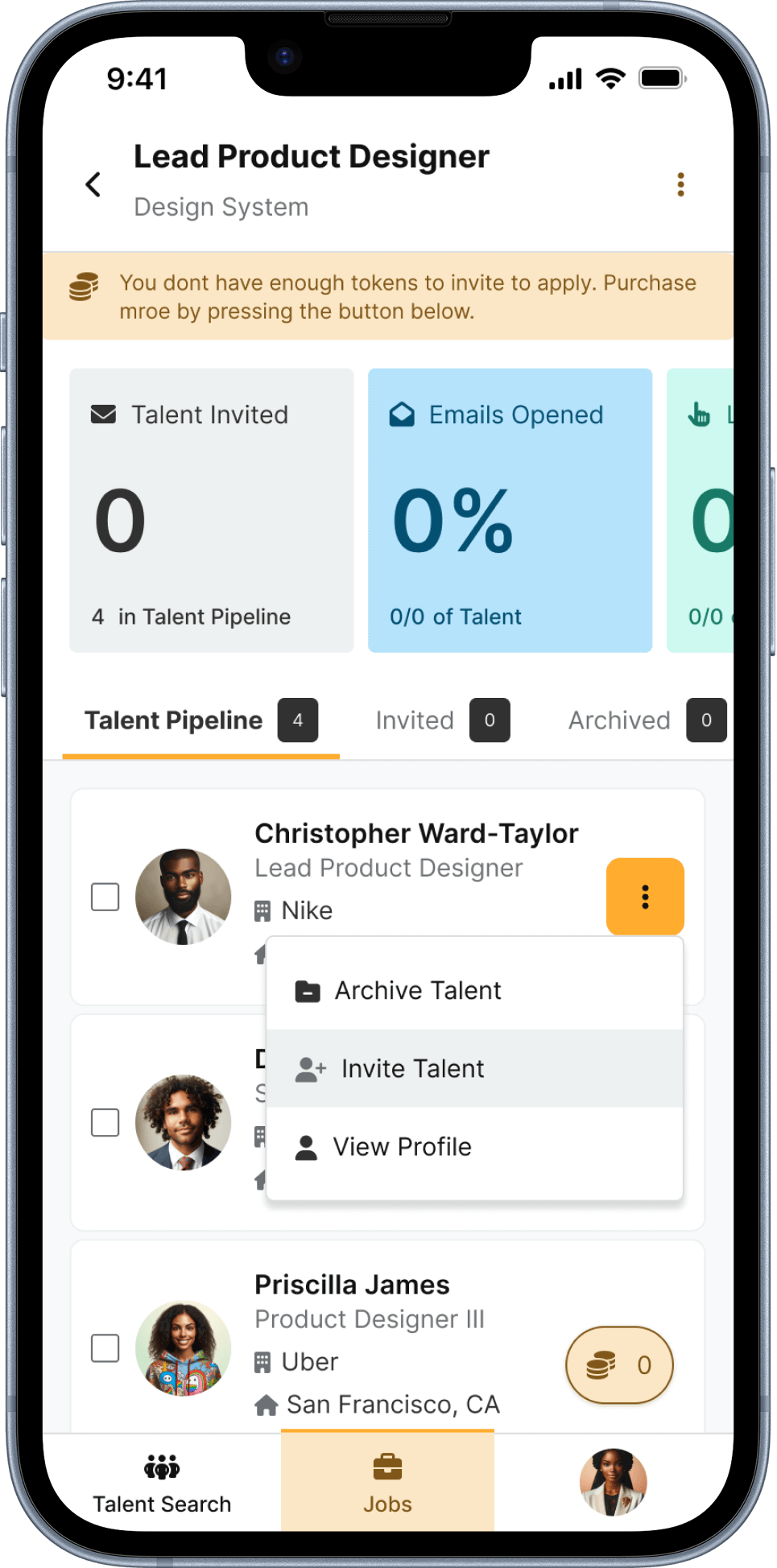
Edge Case(s)
Use Case: An enterprise user attempts to invite talent who has been placed in the pipeline, but their account has no tokens to proceed.
Mobile
Native
Inviting Talent > Talent search
Scenario: Enterprise user searches and selects talent profiles , then adds them to an active job.
Mobile
Native Consideration
Results
The Success We Didnt Anticipate
While initial metrics/projections were modest due to uncertainty of the platform from a business perspective, the collective effort of all involved yielded success that not only proved that Talent Infusion has staying power, but gave us confidence to continue innovating.
enterprise User growth (First 3-Months)
How was this measured? How often was it tracked
100%
Initial Metric
95%
-5%
30-Day Post Release
195 Enterprise New Users
770%
+670%
90-Days Post Release
870 Enterpris Users
Success Insights
By including enterprise users from the beginning stages of the effort and taking their feedback seriously, with each update we provided we saw increase conversions from Fortune 500 companies who were gifted entry into the platform to fully paid memberships. (from 5 to 25 fully vested companies)
Repeat Usage Rate (First 30-days)
How was this measured? How often was it tracked
60%
60 of 100 Active Users
50%
-10%
14-Days Post Release
70%
+10%
30-Days Post Release
Success Insights
We incentivized enterprise users by giving them 50 free tokens to try out the feature. While the initial adoption was strong, engagement dropped once those tokens were used — indicating hesitancy to purchase additional tokens.
...And A minor setback
Due to a last-minute business decision, the iOS version of Talent Infusion was released six months after the initial launch of the web-based application. As a result, the metrics presented reflect only the performance and usage of the web-based app.
Post-Release
Relfection
As A Designer
Talent Infusion was a culmination of every design experience I'd had up to that point—the first time I got to fully apply both my execution skills and untapped leadership capabilities in a single project. Leading 0-to-1 product strategy as a solo designer, I discovered I didn't have to choose between being a craft-focused designer or a strategic leader. I could be both. This project built my confidence in ways I didn't expect, proving to myself that I'm capable across the full spectrum of design
disciplines.
The most valuable lesson: design thrives when there's equal parts challenge
and support. The challenges were real—mid-project team transitions, realigning processes with an offshore team, aggressive timelines. But the support from cross-functional collaborators made those obstacles navigable. This balance pushed me to grow while giving me the foundation
to succeed.
Cross-Functional Collaboration
By introducing the use of AI/LLMs to assist in the design process, we were able to not only accelerate the design portion of this project but created a cadence of communication of how ideas are discussed from a cross-functional perspective. By identifying the bottlenecks and introducing an intermediary which leveled the landscape of the team it provided everyone an equal voice in decision making. Transitioning discussions from primarily “i think” or “I feel” statements to align more with data being front and center.
Business Centered
By established one of the first AI-assisted processes within the organization, it inspired other business areas to establish their own accelertated processes. This has led to the parent company of Talent Infusion (Blavity) leaning heavily into the AI space by facilitating webinars and encouraging the use of it heavily to their audience on social media channels.